There is a peculiar kind of corporate decision that looks like cowardice from a distance and discipline up close. Pocket FM's choice to shut down its microdrama vertical, Pocket TV, is exactly that kind of decision, and it arrives at the strangest possible moment, just as the Indian microdrama industry crosses from novelty into gold rush.
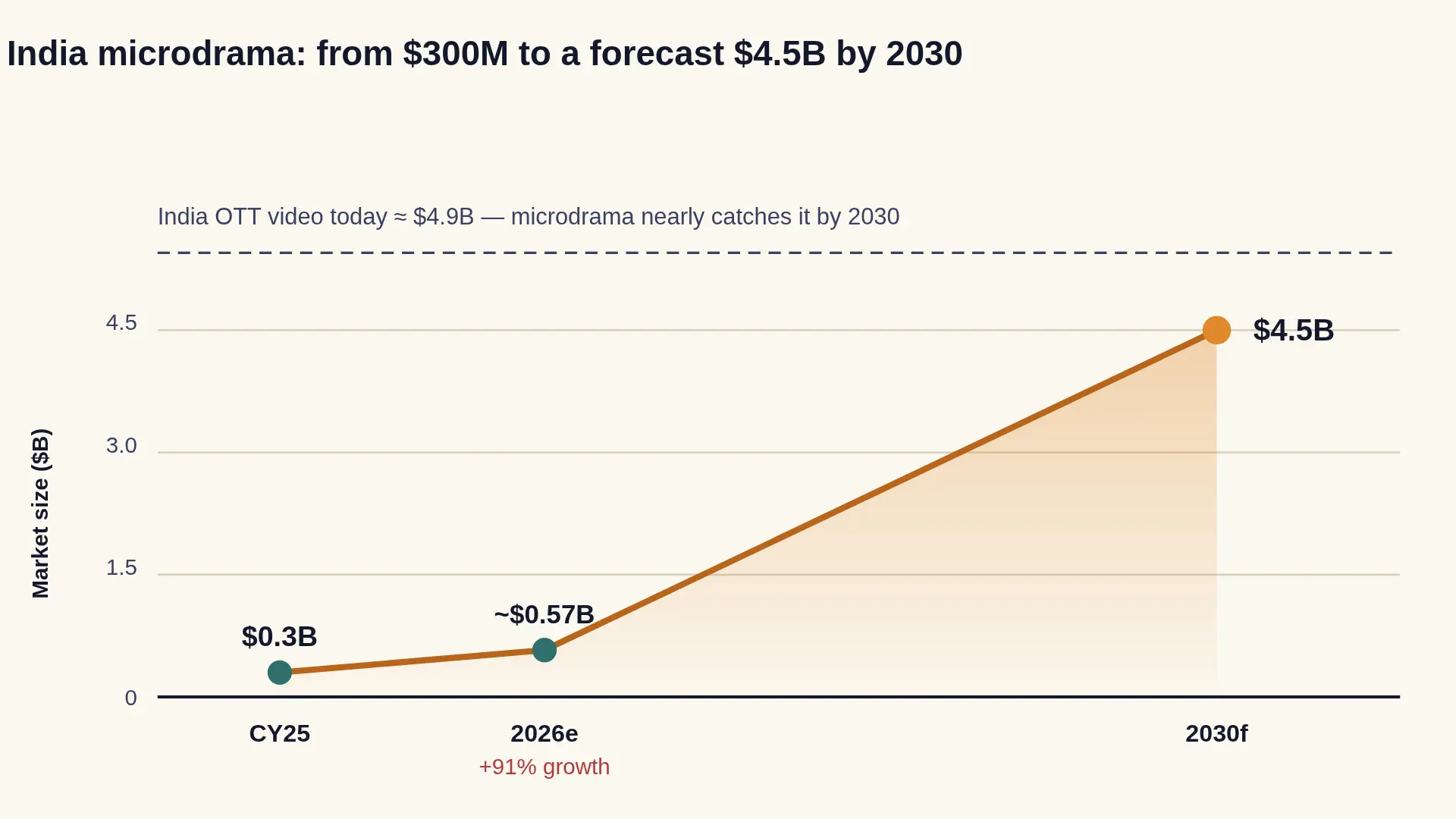
By every external signal, this was the wrong time to leave. The category went from barely registering to a roughly $300 million market in a single year, and Lumikai's State of India Interactive Media 2025 report projects it will grow another 91% in 2026 on its way to $4.5 billion by 2030. JioHotstar's Tadka crossed 100 million users within two months of launch. Kuku TV claims over 200 million downloads and more than 10 million paying subscribers across its apps. Yash Raj Films has committed ₹150 crore, Excel Entertainment has built a dedicated division, and even Shah Rukh Khan's Red Chillies is reportedly circling. The water is warm, the party is loud, and Pocket FM just quietly let go of the rope.
So why walk away from a boom? The official line is simple, Pocket TV was "a beta product to explore the emerging microdrama category" and "not a material contributor" to the business. That is true, but it is the kind of statement that explains a decision without explaining the reasoning behind it. To get at the real forces, it helps to start by killing the laziest theory.

First, the theory we can throw out: money
The tidy narrative - "a cash-strapped startup couldn't afford to keep burning on video" - does not survive contact with Pocket FM's balance sheet. This is not a company running out of runway.
Pocket FM has raised roughly $196.5 million across six rounds from a blue-chip investor base, Lightspeed, StepStone, Tencent, Naver, Goodwater Capital, Tanglin and others. Its $103 million Series D in March 2024, led by Lightspeed, valued it at about $750 million, almost doubling its $390 million Series C valuation in the middle of a brutal funding winter for consumer tech. At the time of that round, CEO Rohan Nayak was explicit: "We're growing sustainably and we're not in that position where we have a runway issue."
More telling than the raise is the revenue. Pocket FM has publicly reported crossing a $400–450 million annualised revenue run-rate by early 2026, up from roughly $150 million ARR in early 2024, and it claims it has already achieved operational profitability in the United States, its largest market, on high gross margins. A company throwing off that kind of cash does not retreat from a category because it cannot afford a few crore of production spend.
If Pocket FM had the money to stay and chose to leave anyway, then money was never the deciding variable. Strategy was.
That reframes the entire question. The exit was not a forced sale; it was a portfolio choice made by a well-funded company that looked hard at the unit economics of video and decided its capital compounded better elsewhere. Here is the reasoning that most plausibly drove it.

The economics of video are brutal in a way audio never was
This is the quiet centre of the whole story. Pocket FM's core audio business runs on an asset that compounds: a library of more than 100,000 hours of audio series, fed by a community of over 300,000 writers and, increasingly, by generative-AI production that the company says cut costs roughly 30x and expanded its catalogue 36x. Once a script is written and voiced, it can be re-listened, re-packaged, dubbed and monetised almost indefinitely at near-zero marginal cost.
Microdrama breaks that model. A vertical video product demands continuous, capital-heavy investment in fresh production, casting, shooting, editing and localization, and it demands it forever. The format's defining feature, the very thing that makes it addictive, is also its financial trap: viewers binge a 60-episode series in a couple of hours and immediately churn unless the next title is already waiting. Analysts call this content exhaustion, and it means a microdrama platform isn't really buying a library, it is renting attention by the week and must keep paying rent in cash.
For a company sitting on a proven, high-margin audio engine, the comparison is unforgiving. Why pour capital into a furnace that needs constant feeding when the same money compounds quietly in the business you already dominate?
The field went from open to overcrowded in twelve months
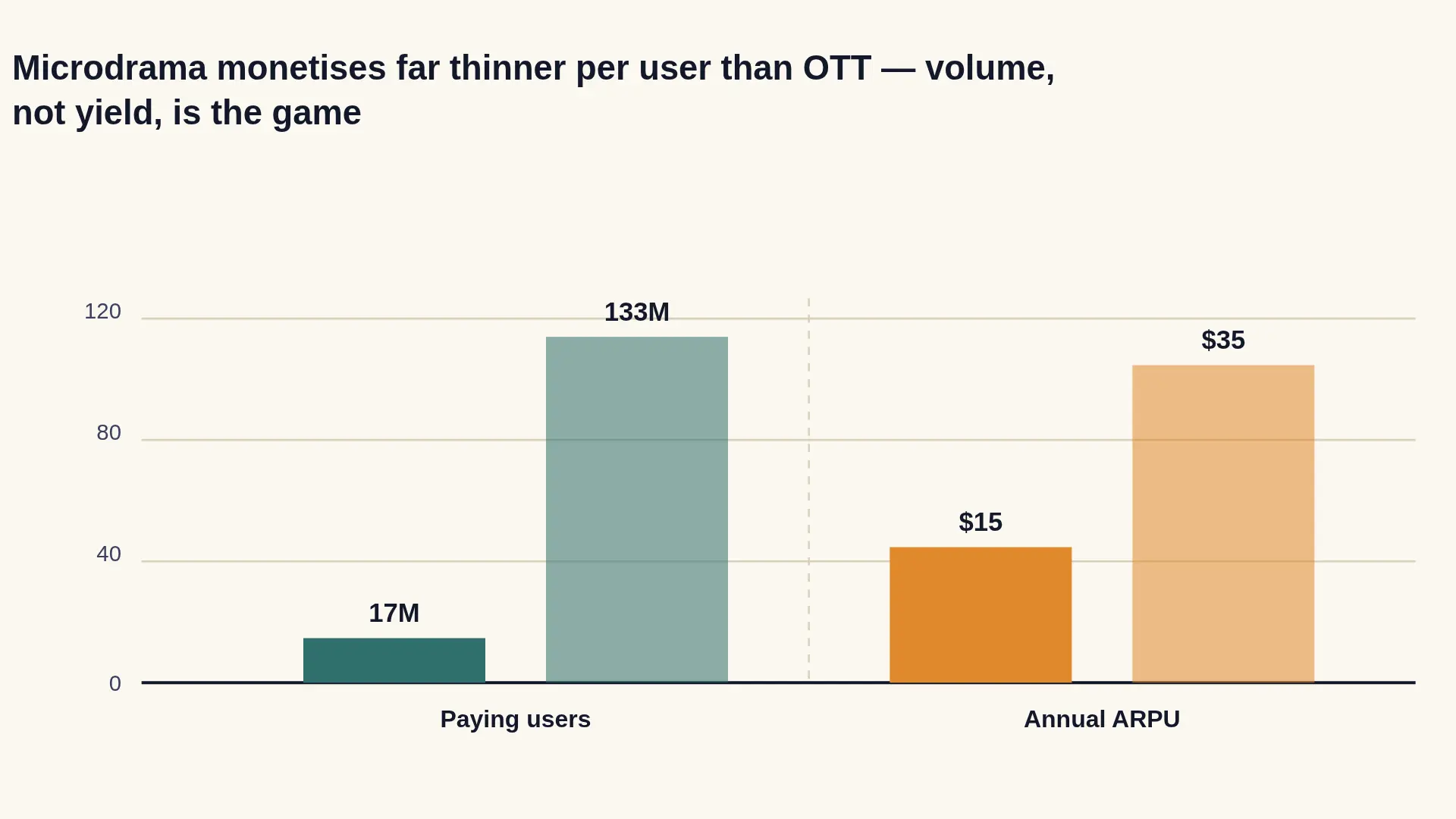
When Pocket TV launched as an experiment, microdrama in India was still a fringe bet. By mid-2026 it had become one of the most crowded arenas in Indian media. Consider who Pocket TV was suddenly standing next to: Kuku TV and Story TV leading the homegrown pack; ShareChat-backed Quick TV; ZEE5's Bullet; Amazon's Fatafat; Balaji Telefilms' Kutting; Hoichoi's Sooper; the Maran family's Tamil-language KadhaiShorts; global libraries DramaBox and ReelShort, and towering over all of them, JioHotstar's Tadka, launched alongside the IPL and riding one of the largest audience funnels on the planet.
In a category where success is bought with content volume and user-acquisition spend, scale is not an advantage, it is the entire game. Against players spending at that altitude, an experimental vertical bolted onto an audio company was never going to out-muscle anyone. Pocket FM likely read the field correctly and concluded that the cost of staying competitive had outrun the strategic value of the experiment.
What happened to the content - and who holds the IP now
One of the most common assumptions about a shutdown like this is that a rival swooped in and bought the catalogue. That did not happen here, and the distinction matters.
Based on the reporting around the closure, no external buyer acquired Pocket TV's content, and the IP was not sold off. Pocket FM is winding the vertical down, not selling it. The company has confirmed there are no layoffs tied to the closure; instead, the employees who built Pocket TV are being reassigned into Pocket FM's core audio operations. The rights to the Pocket TV slate remain with Pocket FM itself.
That is strategically logical, because Pocket FM's entire competence is turning stories into serialized, monetisable audio. Any narrative IP, scripts, story arcs and characters developed for Pocket TV are far more valuable to Pocket FM as raw material it can re-channel into its audio engine, where the margins compound, than as a video library it would have to keep funding or hand to a competitor for pennies. In effect, the company is harvesting whatever creative value Pocket TV generated and folding it back into the business that already works, rather than letting a rival inherit both the catalogue and the team.
So the honest answer to "who gained the rights?" is: nobody outside Pocket FM. The talent went back into audio, and the IP stayed in-house. This was a retreat that deliberately left nothing on the table for competitors to pick up.
An IPO that rewards focus, not sprawl
Timing is the tell. Pocket FM is reportedly preparing for a domestic public listing, including discussions around a "reverse flip" to migrate its holding company back to India. It has been rebuilding its leadership bench, a new CFO arriving from Bank of America, a freshly elevated COO, and a former Meta AI scientist brought in to lead its AI initiatives.
Companies heading toward an IPO do not want to tell a sprawling story; they want a clean one. There is a real-world signal here: when Pocket FM held talks for a fresh round, prospective investors including Prosus and ADIA reportedly sought greater clarity on revenue quality, retention, content expenditure and customer-acquisition economics, and those talks did not convert. A loss-making, capital-hungry video side-bet is precisely the kind of line item that muddies a profitability narrative and invites exactly those awkward questions. Shutting Pocket TV lets the company walk into its listing as what it actually is, the world's leading audio entertainment platform, with audio accounting for the overwhelming majority of its business and a $400M+ run-rate. Pruning the experiment is housekeeping before guests arrive.
The core business is winning, and attention is finite
It is easy to forget, amid the microdrama noise, that Pocket FM's main business is doing extraordinarily well. It claims over 250 million listeners globally, average engagement north of 125 minutes per day, and growth increasingly powered by AI-led content creation and international expansion. When your primary engine is accelerating, every rupee and every senior hour spent on a struggling experiment is a rupee and an hour not spent compounding your win. Re-assigning the Pocket TV team back into core audio is not just cost control, it is a re-concentration of talent onto the part of the business that is actually working.
And, less flatteringly: the product may simply not have landed
There is a blunter possibility worth naming. Pocket TV's public reception was rough, its app-store presence drew sharp complaints about aggressive monetisation, ad-heavy premium tiers, and thin content libraries with half-finished series. None of that is unique to Pocket TV; the entire category fights churn and trust problems. But it suggests the product never found the loyal, paying audience that would have justified doubling down. When an experiment fails to demonstrate product-market fit while the cost of competing keeps climbing, the rational move is to stop, regardless of how hot the overall category looks.
How the biggest players actually make money
To judge whether Pocket FM's caution is wisdom or timidity, it helps to see the economics of the platforms that are staying in. The striking thing is how few of them make real money yet, even the category leader is only "nearing breakeven" after a sevenfold revenue surge.
Leading India microdrama players - revenue & margin snapshot (latest available)
Player | Latest revenue | Profitability | Scale / notes |
|---|---|---|---|
Kuku (Kuku FM + Kuku TV) | ₹1,400 cr+ (FY26) — up ~7× from ₹240 cr FY25 | Near breakeven; prior-year losses from heavy marketing/CAC | 200M+ Kuku TV downloads; 10M+ paying subs; 150+ shows/month; filing ₹3,500 cr IPO at ~₹15,000 cr ($1.8B) valuation |
JioHotstar Tadka | Ad-supported only (no paid tier yet) | Subsidised by JioStar; not separately disclosed | 100M+ users in ~2 months; 100→1,000+ titles planned; backed by JioStar's $10B content spend (2024–26) |
Story TV | ~$40k/month (Sensor Tower, Mar'26) | Early-stage; revenue nascent | 90M+ downloads; #2 microdrama app; top-5 video app by downloads |
Kuku TV (app-level) | ~$50k/month (Sensor Tower, Mar'26) | Sub revenue still small vs. spend | Leads category downloads; >400k global downloads/month |
Pocket FM (for contrast — audio) | $400–450M ARR run-rate, early 2026 | Profitable in the US; high gross margin | 250M+ listeners; the business Pocket TV was being measured against — and lost |
Read together, the table and the chart tell one story: India's microdrama market is enormous in attention and still thin in profit. The leaders are spending furiously to buy downloads and subscribers, betting that scale today converts to margin tomorrow. JioHotstar can afford that because Tadka is a feature inside a $10-billion content machine. Kuku can afford it because it has reframed itself as an IPO-stage growth story where losses are forgiven in exchange for a sevenfold top line. Pocket TV, as a non-core experiment inside a profitable audio company, had neither cover story, its losses would simply have read as drag.

Market outlook: a boom that is also a culling
None of this means the category is overrated. By the numbers, Indian microdrama is one of the most explosive consumer-media stories in the country.
For context, the global signal is even louder: China's short-drama market, where the format originated, has already scaled past $7 billion, roughly three times its traditional box office, and India today shares many of the same enabling conditions (cheap data, ~900 million smartphones, deep regional-language demand, a culture steeped in serialized soap storytelling, and rising willingness to pay).
But the outlook has three hard edges
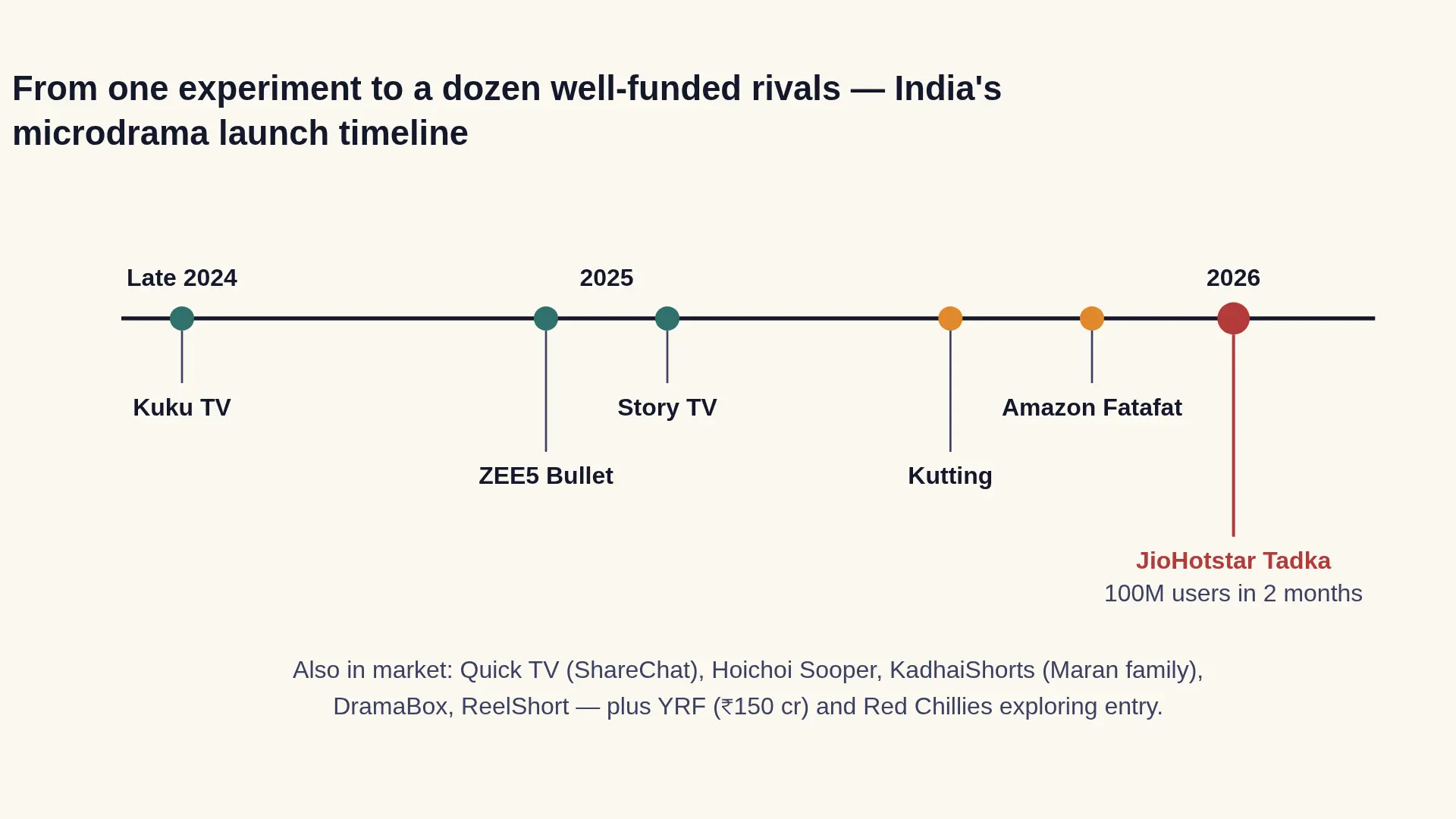
Thin monetisation. At ~17 million paying users and ~$15 ARPU, the category currently converts a fraction of its 100 million MAUs into revenue, and at less than half the per-user yield of OTT. The headline market size is built far more on reach and ad load than on durable subscription economics, which means the path from $300M to $4.5B requires either a step-change in conversion or a flood of advertising money that has not fully arrived.
Capital intensity and a coming shakeout. A market growing 91% a year with a dozen well-funded entrants all chasing the same ~100 million users is not only a gold rush, it is a setup for a brutal consolidation. Booms of this shape rarely reward everyone who shows up; they reward the two or three players with the deepest pockets and the most defensible distribution, and quietly bankrupt the rest. Pocket TV is plausibly the first visible casualty of that logic, not the last.
A quality and trust ceiling. Even bullish industry voices warn that the race for sheer volume is unsustainable, and that long-term winners will be the platforms that invest in genuinely strong storytelling rather than disposable "time-pass." Some practitioners are blunter still, dismissing much of today's output as cheap content. Add the recurring user complaints about coin-gouging and ad-heavy premium tiers, and there is a real risk of audience fatigue capping the category below its most optimistic forecasts.
The most probable shape of the next two years, then, is a barbell: a handful of deep-pocketed winners, JioHotstar's Tadka as the distribution giant, an IPO-funded Kuku as the content-velocity leader, and one or two others, pulling away, while the long tail of sub-scale apps quietly shuts, sells, or pivots, exactly as Pocket TV just did.
The contrarian read
Here is the uncomfortable truth Pocket FM's decision quietly points at. Seen against the data, Pocket FM did not miss the boom. It looked at a furnace of capital burn, a category that monetises at half OTT's yield, an arena dominated by a Reliance–Disney behemoth and a soon-to-IPO Kuku, and its own thriving, profitable, high-margin audio business, and it made the disciplined choice to fold a weak hand rather than keep raising into a pot it was unlikely to win. It did so from a position of financial strength, kept its IP and its people, and walked away leaving nothing for rivals to scavenge.
Sometimes the bravest move in a gold rush is to sell the shovels back and go home to the mine that's already producing.
Whether Pocket FM proves prescient or merely cautious will depend on how the microdrama shakeout plays out over the next two years. If the category consolidates into a profitable barbell, its retreat will look like foresight. If conversion economics crack open and a third or fourth durable winner emerges, it may regret ceding the field. But the logic of its exit is far sounder than the headline, "leaves booming industry", makes it sound. The one thing the numbers make clear is that whatever drove Pocket FM out, it was not a shortage of money.
-Analyzed and Compiled by Rajeev Kumar (Market Research Lead)