

When a Social Media Giant Bets on Micro Drama
There is a pattern emerging in the global entertainment industry that most people have not yet noticed.
The companies best positioned to win the micro drama race are not traditional studios. They are not production houses with decades of film industry experience. They are social media platforms, companies that already have hundreds of millions of users, sophisticated content recommendation engines, and deep data on what audiences watch, skip, and rewatch.
In China, this pattern played out when Kuaishou, a short-video platform with over 600 million users became one of the first to launch a dedicated micro drama section, turning its existing audience into a captive viewership for serialised short-form storytelling. The logic was simple: if you already own the attention, you just need to give it a format.
In India, the company making this exact move is Mohalla Tech, the parent company of ShareChat, India's largest vernacular social media platform, and Moj, one of the country's leading short-video apps. Their micro drama bet is called QuickTV. And their international expansion is powered by Sukudo Studios.
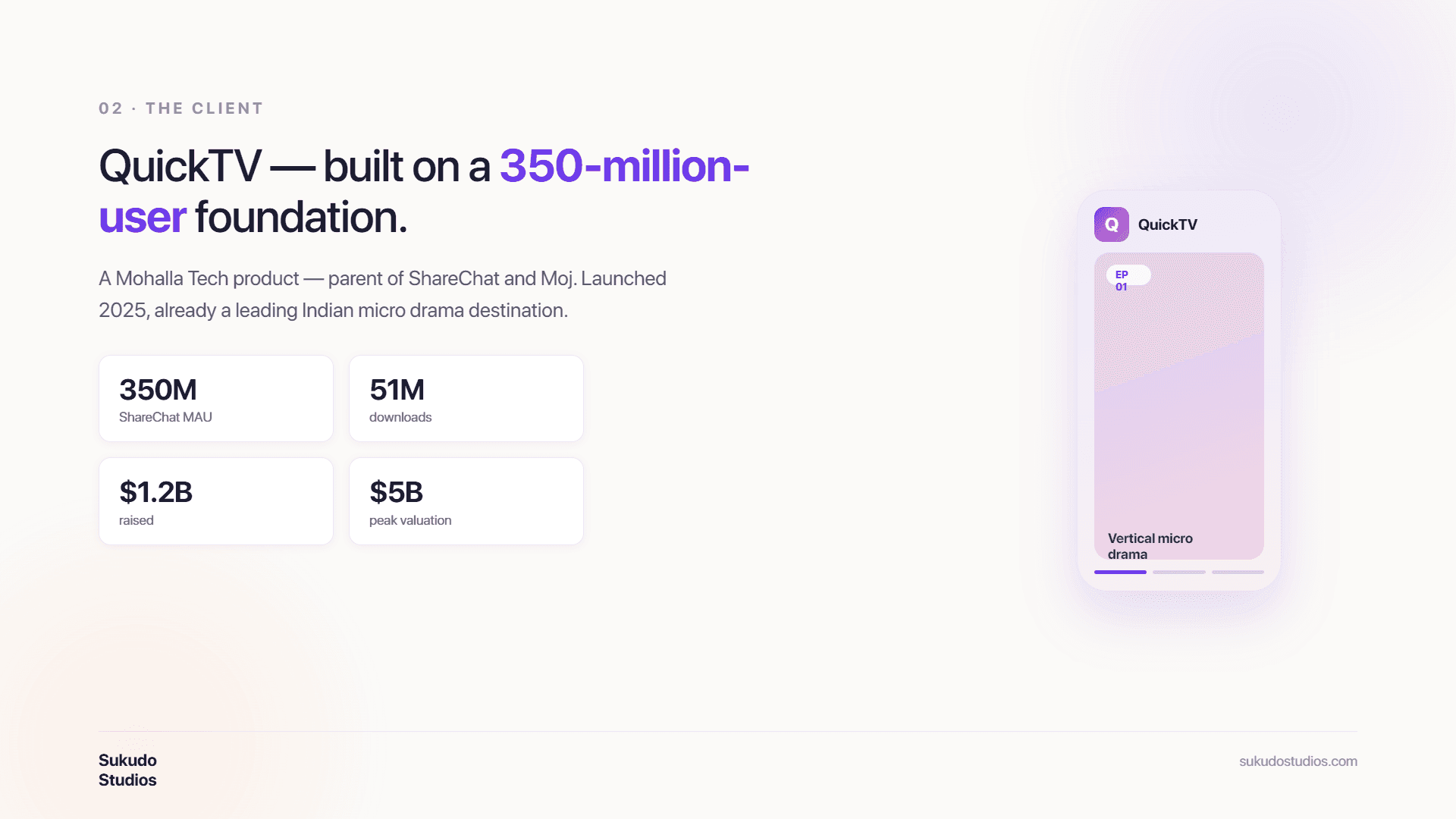
The Client: QuickTV - A Micro Drama Platform Built on a 350-Million-User Foundation
QuickTV is not a standalone startup trying to find its audience from scratch. It is a product of Mohalla Tech, one of India's most significant consumer technology companies.
Mohalla Tech was founded in 2015 by IIT Kanpur graduates Ankush Sachdeva, Bhanu Pratap Singh, and Farid Ahsan. The company's flagship product, ShareChat, grew into India's largest regional-language social media platform, serving content in over 15 Indian languages to more than 350 million monthly active users. The short-video platform Moj, launched after TikTok's ban in India, further cemented Mohalla Tech's dominance in vernacular content.
The company's investor roster reflects the scale of its ambition. Mohalla Tech has raised over $1.2 billion in total funding from some of the world's most prominent technology investors, including Google, Temasek Holdings, Tiger Global Management, Lightspeed Venture Partners, and Tencent. At its peak, the company was valued at $5 billion. It is now actively charting a path toward a public listing, with reports indicating an IPO timeline within two years.
QuickTV, launched in 2025, is Mohalla Tech's entry into the micro drama format. The platform has already crossed 51 million downloads, offering Hindi, Tamil, and Telugu short dramas alongside dubbed international content. With a library spanning romance, revenge, family sagas, fantasy, and CEO dramas, delivered in the vertical, swipe-to-watch format that mobile-first audiences prefer, QuickTV has rapidly established itself as one of India's leading micro drama destinations.
But Mohalla Tech's plans for QuickTV extend well beyond India.

The Strategic Bet: Indian Micro Drama for Arabic and English-Speaking Audiences
QuickTV's domestic growth was never the full vision. Mohalla Tech understands something fundamental about the micro drama format: it is inherently global. A two-minute episode built on romance, betrayal, family honour, and social mobility does not need a passport. It needs a dubbing partner.
The company identified two high-priority international markets for its first wave of expansion:
The Arabic-speaking Middle East. The Gulf region and broader MENA market represent one of the most compelling opportunities for Indian content. The cultural connections run deep, decades of Bollywood consumption, a massive South Asian diaspora, and a shared appetite for dramatic, emotionally rich storytelling. Smartphone penetration in the Gulf states is among the highest in the world, and mobile entertainment consumption is growing rapidly. Indian micro dramas, with their themes of family conflict, hidden identities, and social aspiration, resonate naturally with Arabic-speaking audiences when properly adapted.
The English-speaking world, starting with the United Kingdom. The UK market is distinct from the American one. British audiences have their own cultural sensibilities, idiomatic preferences, and expectations around tone and emotional register. UK English dubbing is not simply American English with a different accent, it requires a fundamentally different approach to dialogue adaptation. For QuickTV, the UK represents both a direct market and a gateway to the broader English-speaking world, including the substantial Indian diaspora across Europe and the Commonwealth.
The challenge was finding a dubbing partner who could handle both markets simultaneously, with the quality, speed, and cultural precision that a company of Mohalla Tech's scale demands.

The Challenge: Two Markets, Two Languages, One Standard
Expanding into Arabic and English-speaking markets simultaneously is not a simple matter of translating scripts and recording voiceovers. Each market presents its own set of localisation complexities.
Arabic localisation is technically and culturally demanding. Beyond the obvious challenge of adapting dialogue into Arabic, there are decisions that affect every aspect of the viewing experience. Dialect selection is critical, Modern Standard Arabic (MSA) provides broad accessibility across the region, but the emotional register of a romance or family drama often calls for a more colloquial tone that feels natural rather than formal. Cultural adaptation must navigate sensitivities around family dynamics, social hierarchy, and relationship portrayal that differ meaningfully between Indian and Arab cultural contexts. Any on-screen text elements titles, captions, text messages within scenes need to account for right-to-left formatting.
UK English dubbing requires its own form of cultural intelligence. American English has become the default for much of the global dubbing industry, but British audiences can immediately tell when dialogue has been written for an American ear. Idioms, humour, emotional expression, and even the rhythm of casual conversation differ between the two markets. A line that sounds natural in an American dub can feel awkward or tonally off to a British viewer. For QuickTV's content which trades on emotional immediacy and viewer immersion this kind of subtle disconnect can erode the experience.
Both markets demand consistency at scale. QuickTV's content library is not a handful of titles. It is a continuously growing catalogue of series, each with dozens of episodes, releasing on a cadence that does not pause. The dubbing partner cannot treat each title as a one-off project. It needs to operate as an extension of QuickTV's content pipeline maintaining character voice continuity, quality standards, and delivery schedules across every title, in both languages, simultaneously.
And it all needs to meet the bar of a pre-IPO company. Mohalla Tech is on a documented path toward a public listing. Every partnership, every vendor relationship, every piece of content that carries the QuickTV brand is held to a standard that reflects the scrutiny a public company faces. Content security, contractual reliability, and consistent delivery are not preferences they are requirements.

Why QuickTV Chose Sukudo Studios
Sukudo Studios had already proven its capabilities in the exact category QuickTV needed: taking Indian micro drama content and making it resonate with international audiences. As the established international dubbing partner for KukuTV, India's largest micro drama platform — Sukudo had built the workflows, assembled the talent, and refined the cultural adaptation processes that this kind of work demands.
For QuickTV, this track record was not incidental. It was decisive.
Proven micro drama dubbing infrastructure. Sukudo Studios is not a generalist dubbing house experimenting with short-form content. Its pipeline is purpose-built for the micro drama format, high-volume, short-episode series with fast turnaround requirements and zero tolerance for quality inconsistency between episodes.
Rare multilingual range under one roof. Finding a single Indian dubbing studio with genuine expertise in both Arabic and UK English localisation is uncommon. Most studios specialise in one language pair or one regional market. Sukudo's ability to handle both markets simultaneously, with dedicated teams for each, meant QuickTV could consolidate its international dubbing with a single partner rather than managing separate vendors per language.
Cultural adaptation depth. Sukudo does not treat dubbing as a translation exercise. For Arabic, this means dialogue that feels emotionally authentic to Gulf and MENA audiences, not a stiff, formal rendering that sounds like a news broadcast. For UK English, this means scripts that sound like they were written in English, not translated into it. The adaptation team understands the source material (Indian storytelling conventions) and the target audience (Arabic-speaking and British viewers) well enough to bridge both without losing what makes the stories compelling.
Pricing that supports growth-stage economics. QuickTV's international expansion is an investment. Mohalla Tech is deploying capital toward content localisation before the international revenue fully materialises. The dubbing partner's pricing cannot be a luxury expense, it needs to support a unit economic model where each localised title earns back its dubbing cost through viewer acquisition and retention in the target market. Sukudo's competitive pricing makes the international expansion model work financially, not just creatively.
Content security and operational reliability. For a company on an IPO trajectory, vendor reliability is not a soft requirement. Sukudo's secure workflows, NDA-backed processes, and consistent delivery track record met the governance standards that Mohalla Tech applies across its vendor ecosystem.

What Sukudo Studios Delivers
Sukudo Studios is QuickTV's dubbing partner for its expansion into Arabic-speaking and English-speaking markets, handling end-to-end localisation for the platform's Indian micro drama content.
The scope of the partnership covers:
Arabic dubbing and cultural adaptation- transforming Indian micro drama narratives into content that feels native to Arabic-speaking audiences across the Middle East, with attention to dialect, cultural nuance, and emotional register.
UK English dubbing and cultural adaptation- localising Indian content for British and English-speaking audiences with dialogue that sounds naturally written in English, calibrated for British cultural sensibilities rather than defaulting to American English conventions.
Script adaptation- going beyond literal translation to ensure that Indian storytelling tropes (family honour, hidden identity, social mobility, arranged marriage dynamics) are contextualised for audiences who may not share the same cultural reference points.
Ongoing delivery at scale- operating as a continuous extension of QuickTV's content pipeline, not a project-based vendor. As new titles enter the platform's catalogue, they flow through Sukudo's dubbing pipeline in both languages, maintaining character continuity and quality standards across every episode of every series.

The Bigger Picture: The Social Media-to-Micro Drama Pipeline
QuickTV's story represents something larger than a single platform's international expansion. It signals the emergence of a new industry archetype: the social media company that becomes a micro drama powerhouse.
The logic is compelling. Social media platforms like ShareChat already possess three things that standalone micro drama startups spend years building: massive user bases, sophisticated recommendation algorithms, and deep data on audience behaviour. When these platforms launch micro drama verticals, they skip the cold-start problem entirely. The audience is already there. The distribution engine is already running. The only missing piece is content and with India's rich storytelling tradition and an established ecosystem of production talent, content is solvable.
What is less solvable and what separates the platforms that succeed internationally from those that remain domestic is localisation. The social media-to-micro drama pipeline only works globally if the content can travel. And content travels when the dubbing is invisible when a viewer in Riyadh or London presses play and simply experiences a story, without ever thinking about the fact that it was originally made in Hindi.
This is the infrastructure Sukudo Studios provides. Not just dubbing, but the bridge between Indian storytelling and global audiences built to operate at the speed and scale that social media-era entertainment demands.
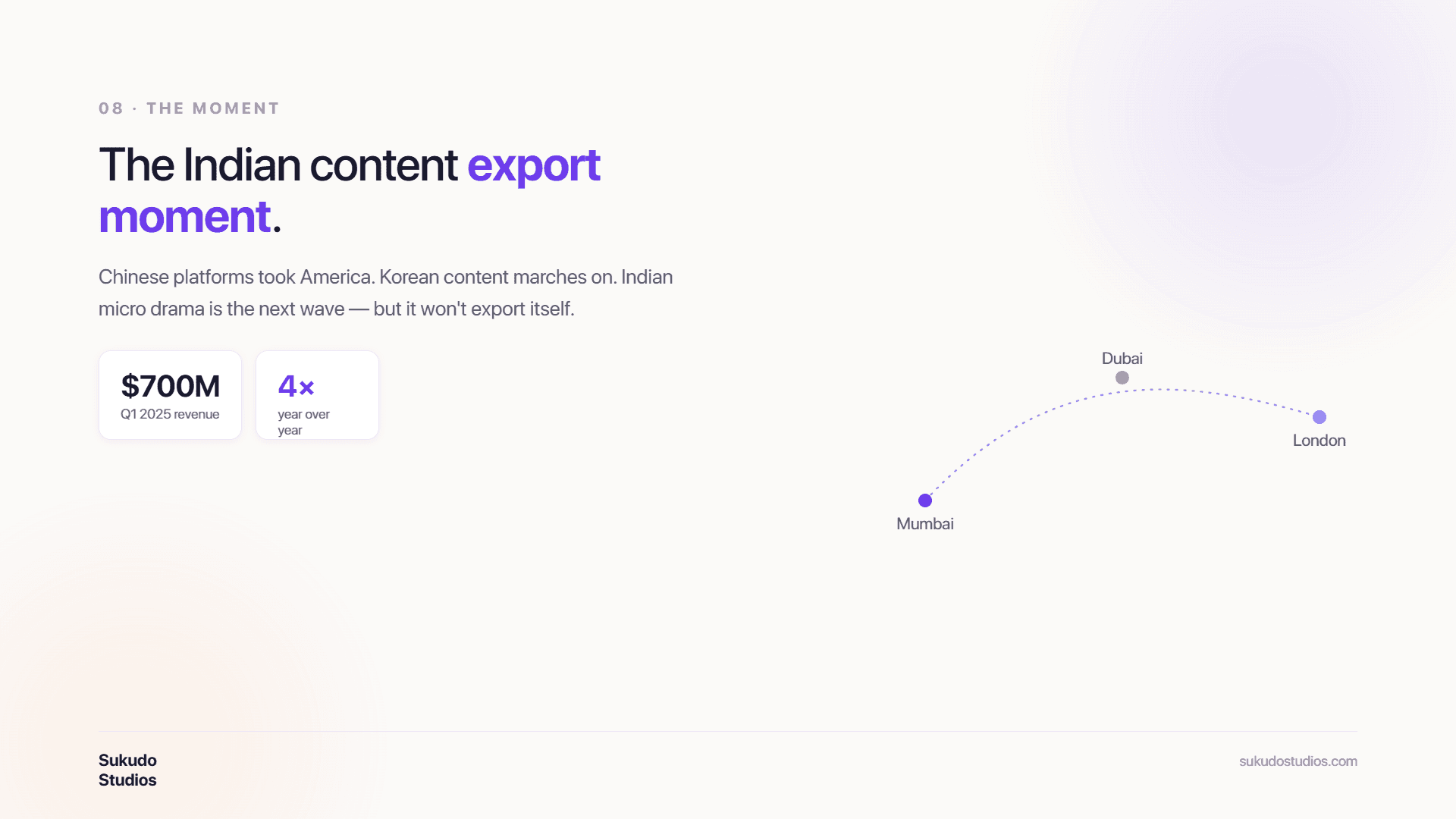
The Indian Content Export Moment
India's micro drama industry is at an inflection point. Domestically, the market is maturing rapidly- platforms are competing fiercely for viewers, content libraries are expanding, and production quality is rising. But the real prize lies in international markets.
Global micro drama revenue reached $700 million in Q1 2025 alone, a fourfold increase from the previous year. Chinese platforms like ReelShort and DramaBox have captured the American market. Korean content continues its global march. Indian content- with its emotional depth, family-centric narratives, and dramatic intensity, is the next wave.
But Indian content will not export itself. It needs partners who understand both the source and the destination. Partners who can take a story conceived in Mumbai or Bengaluru and make it land in Dubai and London with the same emotional force.
QuickTV, backed by the resources and ambition of a billion-dollar social media company, is making this bet. Sukudo Studios is the partner making it possible.
Working with Sukudo Studios
Sukudo Studios is India's specialist dubbing and localisation studio for the micro drama era, serving platforms, content creators, and OTT companies that need studio-grade multilingual dubbing at the speed and scale the format demands.
Whether you are expanding into the Middle East, the UK, Southeast Asia, or any other global market Sukudo Studios offers end-to-end dubbing and cultural adaptation under one roof, with the pricing, quality, and turnaround that micro drama platforms require.
Get in touch: Contact Sukudo Studios