
The Bet Nobody in the Indian Film Industry Is Making
Picture a living room in Kuala Lumpur, or Johor Bahru, or a housing estate on the outskirts of Kuantan. It's 2027 or 2028. A Malaysian family is scrolling through their smart TV, looking for something to watch after dinner. They stop on a title in the FAST channel guide, or on a YouTube thumbnail with a Malay-language preview.
The film they open is Rishtey. Anil Kapoor is on screen. Karisma Kapoor is on screen. Shilpa Shetty is on screen. Amrish Puri, in his signature scowl, is on screen. But the language coming out of their mouths, the emotion, the anger, the tears, the reconciliation, is Malay.
For the family watching, it's not a foreign film. It's the kind of family drama they've been consuming on Malaysian television and Indonesian streaming for years, only with faces they vaguely remember from when Astro used to run a Bollywood channel called B4U on channel 133 - a channel that went off air in 2012 and was never replaced.
That is the future one Indian film library owner decided to bet on. And Sukudo Studios is the partner they chose to bring it to life.
The Client - And Why We're Not Naming Them Yet
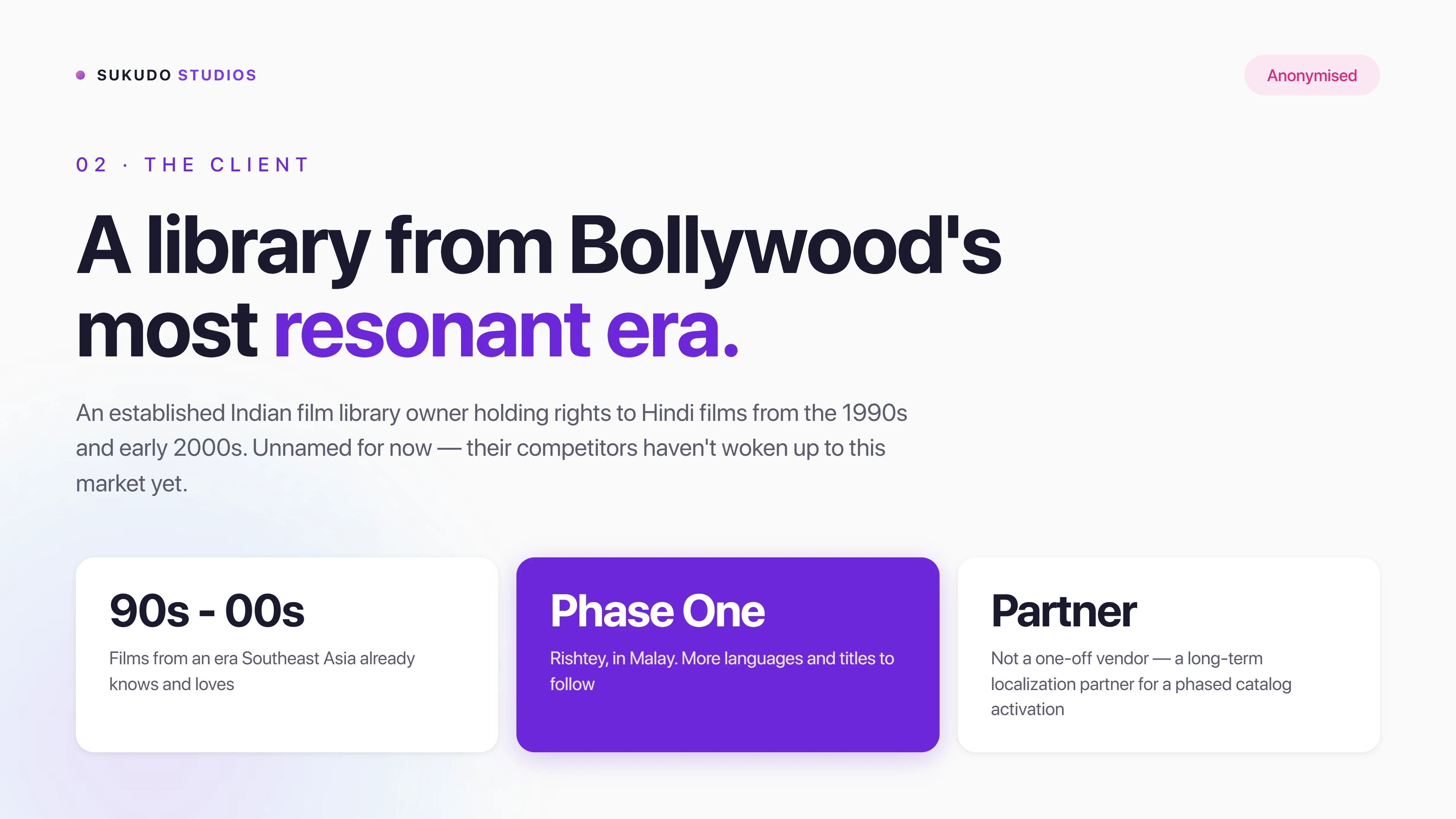
The client for this project is an established Indian film library owner with rights to a curated collection of Hindi-language films from the 1990s and early 2000s - arguably the most commercially resonant era of Bollywood cinema for Southeast Asian audiences.
We're keeping their identity confidential for now, because the market they're entering is a market their competitors haven't fully woken up to. But the details of the project and the strategic thinking behind it are worth telling openly, because this case study is not really about one film or one client. It's about a much larger opportunity that most of the Indian film industry is currently sleeping on.
What matters to know about the client:
They hold rights to a library of films from an era Southeast Asian audiences already know and love
They intend to expand this dubbing initiative into additional Southeast Asian languages across additional titles from the same catalog era
They approached Sukudo Studios not as a one-off dubbing vendor but as a long-term localization partner for a phased catalog activation
Phase One is Rishtey. In Malay. That's where this story begins.
The Film - Rishtey (2002)
For readers unfamiliar with the film, some context is worth setting.
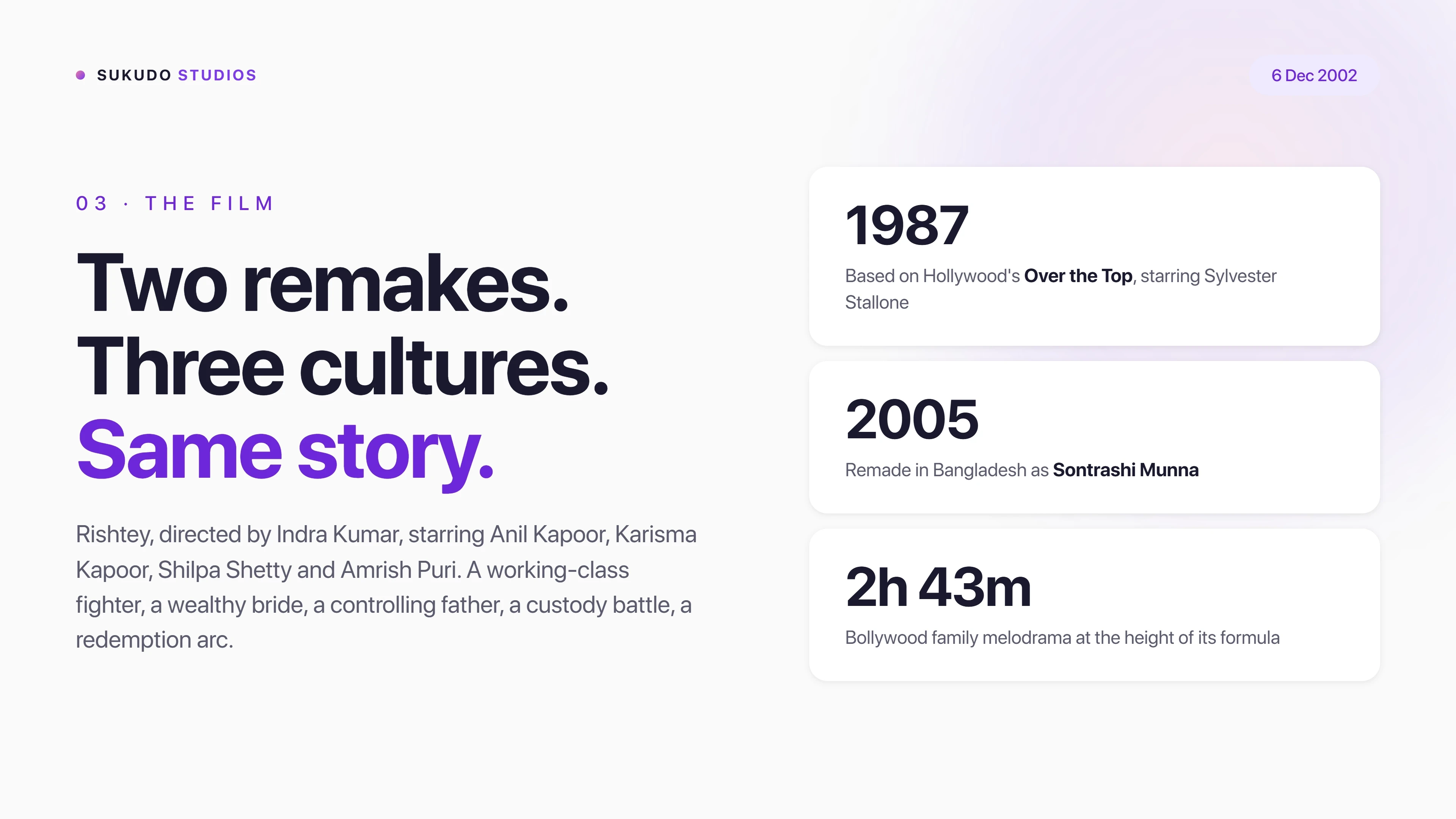
Rishtey released on 6 December 2002. Directed by Indra Kumar, produced by Indra Kumar and Ashok Thakeria, it starred Anil Kapoor, Karisma Kapoor, Shilpa Shetty, and the incomparable Amrish Puri, with strong supporting turns from Sadashiv Amrapurkar and Alok Nath. Cinematography by Baba Azmi, music by Sanjeev Darshan, background score by Ranjit Barot.
The plot is what Indian cinema does best. Suraj Singh, a working-class amateur fighter, falls in love with the wealthy Komal Chaudhary. Her controlling father Yashpal, played by Amrish Puri, obviously, because who else, disapproves violently. The lovers marry against his wishes. A child is born. And then, through a manufactured misunderstanding, the marriage is torn apart. What follows is a father raising his son alone, a mother searching for the family she was made to abandon, a custody battle, and a redemption arc that spans years.
Runtime: 2 hours 43 minutes. Standard Bollywood family melodrama, executed at the height of its formula.
Here's a detail that matters more than it might seem: Rishtey was itself based on the 1987 Hollywood film Over the Top, starring Sylvester Stallone. And in 2005, it was remade in Bangladesh as Sontrashi Munna, starring Manna and Moushumi.
Two remakes. Three cultures. Same story working across all of them.
That is not an accident. That is a signal.
Why This Film - And Why This Market
The client's decision to lead their Southeast Asian expansion with Rishtey was not random. It was a calculated choice built on a specific insight about what actually travels across Asian audiences.
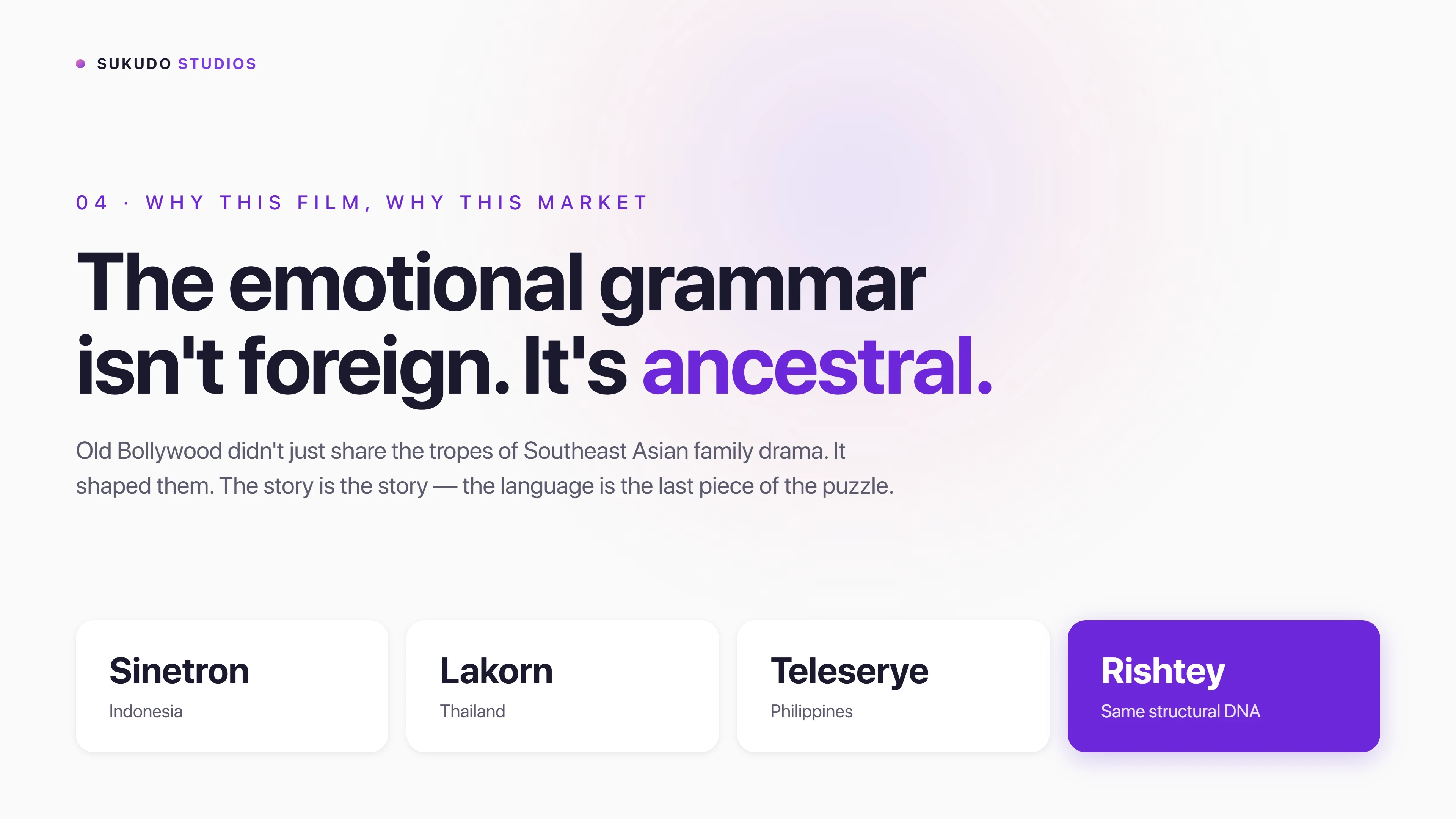
Watch an Indonesian sinetron for ten minutes. Then a Thai lakorn. Then a Filipino teleserye. Then watch Rishtey. You will notice the same structural DNA- the rich family versus the poor family, the forbidden love, the wronged spouse, the child caught between parents, the villainous patriarch, the climax that involves everyone weeping at either a wedding or a hospital bed.
Old Bollywood didn't just have the same tropes as Southeast Asian family drama. It shaped them. For an entire generation of Southeast Asian viewers the same generation who watched Mahabharat dubbed on TPI in Indonesia, or Kumkum Bhagya on Antv, or the Khans on Astro's Bollywood channel the emotional grammar of a film like Rishtey is not foreign. It's ancestral.
The Bangladesh remake is the tell. If a Bengali audience could receive this exact story, in their language, with their actors, and embrace it as their own, then a Malay audience, or an Indonesian audience, or a Thai audience, will do the same. The story is the story. The language is the last piece of the puzzle.
The client saw this. Sukudo Studios helped build the bridge.
The Bigger Opportunity Behind This One Film
Here is why the client's insight is more important than the individual film and why more Indian rights-holders should be paying attention.
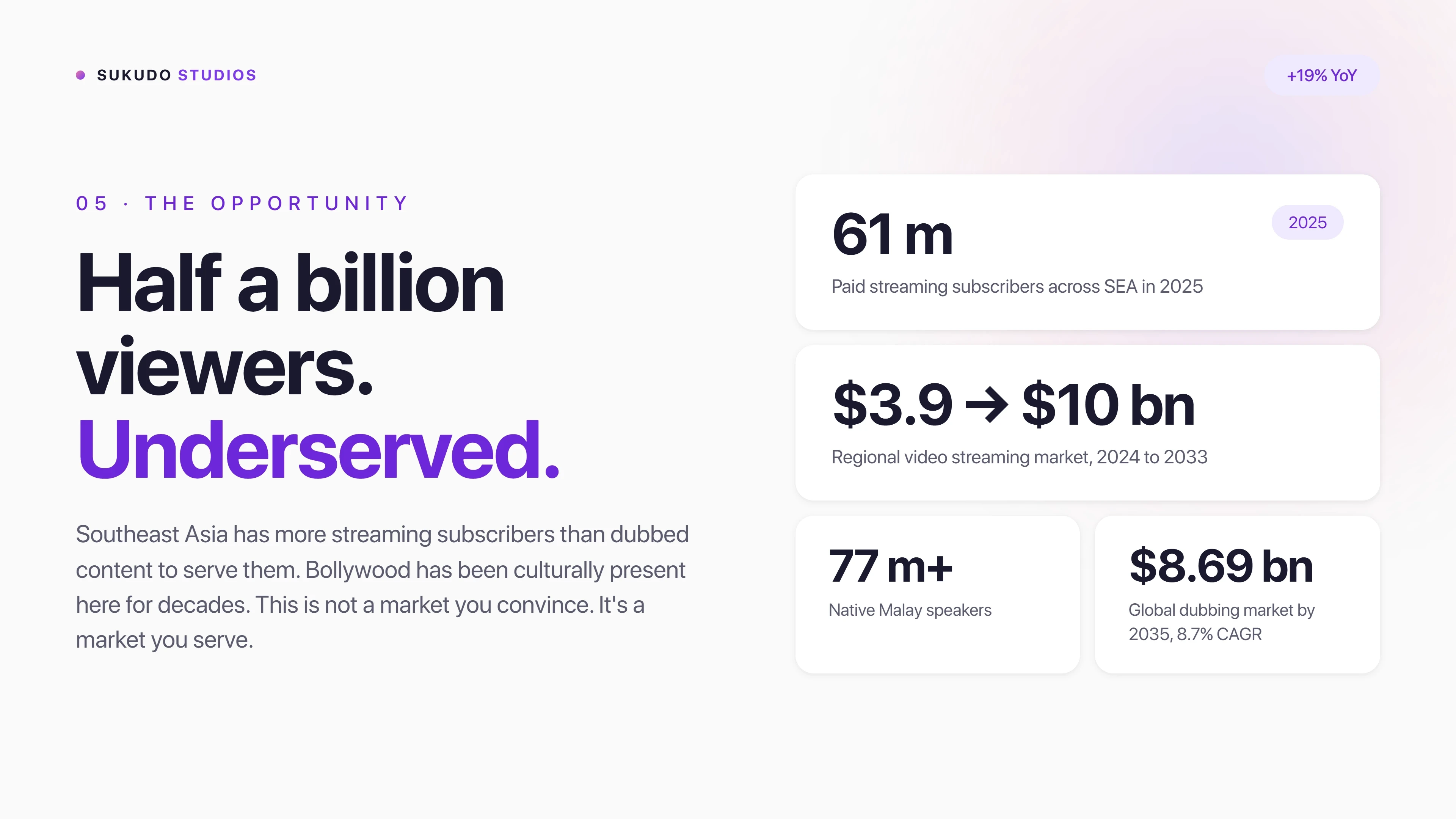
Southeast Asia's streaming market is exploding. Paid streaming subscribers across Indonesia, Thailand, the Philippines, Malaysia, and Singapore crossed 61 million in 2025, growing 19% year-on-year, according to Media Partners Asia. The overall regional video streaming market is projected to grow from $3.9 billion in 2024 to $10 billion by 2033.
The global film dubbing market is racing to keep up. The industry is projected to grow from $4.1 billion in 2026 to $8.69 billion by 2035, a compound annual growth rate of 8.70%. Southeast Asia is specifically flagged by market research firms as "underserved for dubbing relative to subscriber growth." Translation: there are more streaming subscribers in the region than there is dubbed content to serve them.
Malay dubbing alone opens up 77 million+ native speakers, across Malaysia, Bahasa Melayu speakers in Indonesia, Brunei, and Singapore. When you add Bahasa Indonesia (280 million), Thai (60 million), Vietnamese (85 million), and Filipino/Tagalog (45 million), you're talking about half a billion viewers in a single regional bloc.
And the historical infrastructure is already there. Bollywood has been culturally present in Southeast Asia for decades, through television dubbing in Indonesia, satellite channels in Malaysia, cinema releases across Singapore and Thailand, IIFA Awards ceremonies hosted in Malaysia (2002), Singapore (2004), and Thailand (2008). This is not a market you have to convince. It's a market you have to serve, and the moment you serve it well, in the language it prefers, it responds.
For a deeper look at the market context around this opportunity, we've written a companion piece: The Sleeping Goldmine - Why Your Old Bollywood Library Belongs in Southeast Asia.

The Challenge
Taking a 24-year-old Hindi-language film and making it feel native to a modern Malaysian viewer is not a technical problem. It's a cultural translation problem, layered on top of a technical one.
The dialogue is dated. Rishtey was written in the Hindi conversational register of 2002. Slang has moved on. Idioms have shifted. A direct translation would render dialogue that felt fossilised, even if the underlying story remained emotionally intact. Malay adaptation had to preserve the emotional arc while landing in a way that Malaysian audiences of today would recognise as living, spoken language.
Cultural markers need remapping. Indian family structures, forms of address, terms of respect, and social hierarchies do not map one-to-one onto Malaysian equivalents. Some are close enough to translate directly. Others need to be re-imagined, a Malaysian audience needs to instinctively understand who has power in a scene, who is deferring, who is transgressing, and what the emotional stakes are.
Songs are a decision, not a default. Hindi film songs are integral to the storytelling in a film like Rishtey. But they don't operate the same way in Malaysian entertainment traditions. Every song sequence became a decision point: dub the vocals into Malay, retain the original Hindi with Malay subtitles, or handle them instrumentally with visual context. There is no universal right answer only the right answer for each specific song's role in the film.
Anil Kapoor sounds like Anil Kapoor. When you dub a film with actors as recognisable as Anil Kapoor, Karisma Kapoor, and Shilpa Shetty, casting the Malay voice performers is not just about finding actors with the right gender and age. It's about finding performers whose vocal texture, energy, and emotional range can carry the weight that these on-screen stars carry. A weak voice cast breaks the illusion before the film even gets to its first act.
And it all has to be delivered at a price that makes catalog monetization economically viable. Dubbing costs cannot outrun the revenue potential of the dubbed asset otherwise, the entire library-activation model breaks down. Every efficiency in the pipeline directly affects whether this is a one-film experiment or a scalable strategy.
What Sukudo Studios Delivered
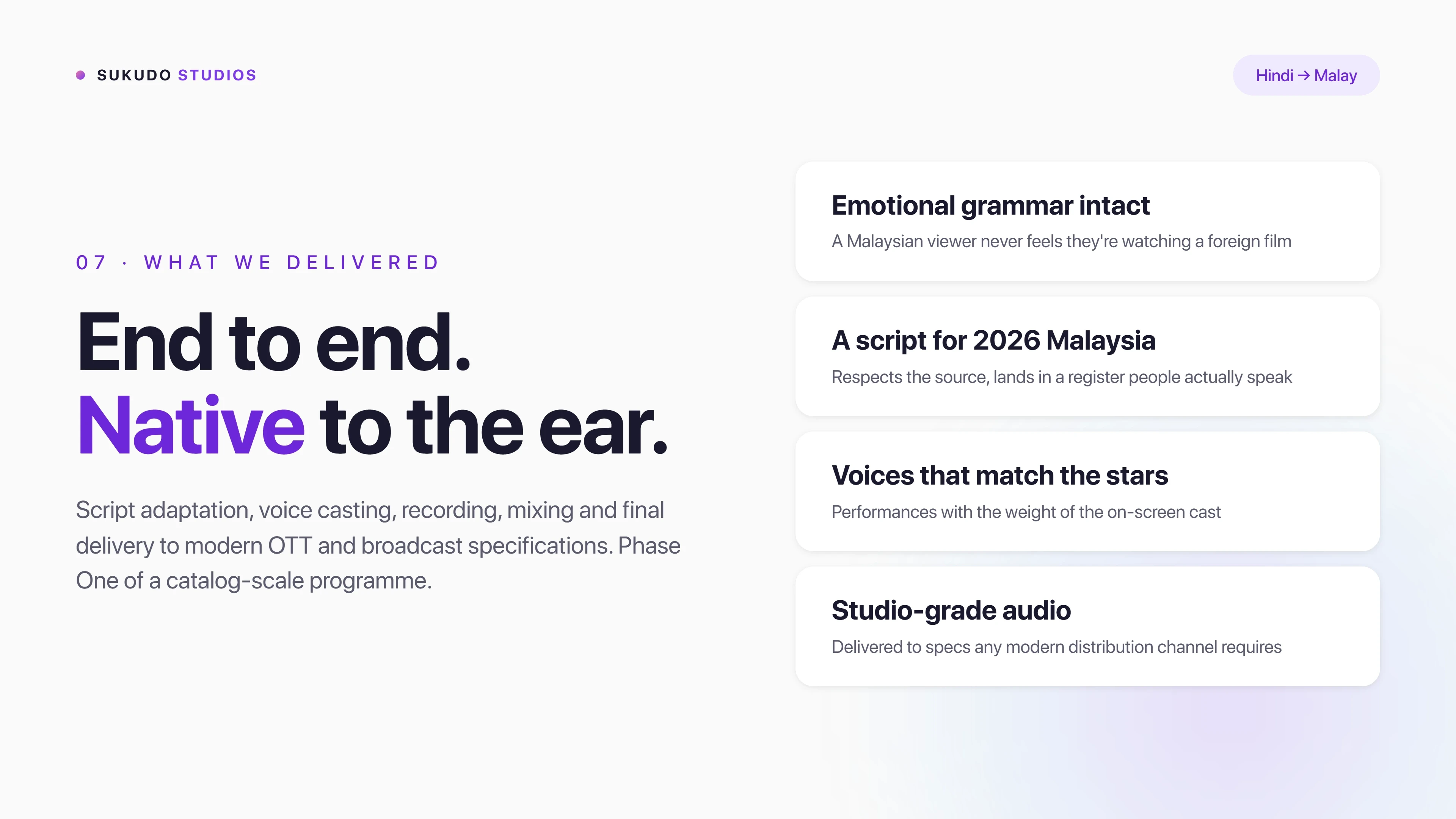
Sukudo Studios delivered the full end-to-end Hindi-to-Malay dubbing of Rishtey script adaptation, voice casting, recording, mixing, and final delivery to modern OTT and broadcast specifications.
The details of how we did it are, understandably, proprietary. But the outcome is what matters:
A Malay-dubbed version of Rishtey that a Malaysian viewer can put on their television without ever feeling they are watching a foreign film the emotional grammar intact, the dialogue naturally spoken, the star performances honoured
A localised script that respects the source material while landing in a cultural register a 2026 Malaysian audience actually speaks
Voice performances that match the weight of the on-screen cast
Studio-grade audio delivered to specs that meet any modern distribution channel's requirements
More importantly: this is not a standalone deliverable. This is Phase One of a longer partnership. The client has indicated intent to expand into additional Southeast Asian languages and additional titles from the same era of their catalog. What began with one film is being architected as a catalog-scale localization programme.

Where This Content Can Live - The Southeast Asian Distribution Landscape
Since every rights-holder reading this case study will inevitably ask "and then what?", it's worth mapping out the distribution channels that make this kind of catalog activation commercially viable in Southeast Asia today.
YouTube with Multi-Language Audio (MLA). YouTube now allows a single video to carry multiple dubbed audio tracks. Upload your film once, add Malay, Bahasa Indonesia, Thai, and Vietnamese dubs, and every viewer in every country sees it in their language on the same URL. This is the most scalable channel, ad-supported, global, no licensing negotiations required. Existing operators like Shemaroo Bollywood Bahasa Dubbed have already proven the model at scale.
FAST channels (Free Ad-Supported Streaming TV). Samsung TV Plus grew six-fold in Southeast Asia in its first year. LG Channels, Xumo, and regional operators are actively expanding their content libraries. FAST channels need catalog content to fill 24/7 linear programming, and dubbed Bollywood classics slot naturally into their programming grids. This is one of the fastest-growing content categories in the region.
Regional OTT platforms. Vidio in Indonesia (45M+ monthly active users). Viu across Malaysia, Indonesia, Thailand, the Philippines, and Singapore. WeTV with its stronghold in Thailand. Astro Sooka in Malaysia. Vision+ in Indonesia (110M+ MAUs). Each of these platforms licenses catalog content, and each is looking for library depth in genres their audiences already love.
Dedicated Bollywood linear channels. Malaysia's Astro used to run B4U as a full Bollywood channel until it closed in 2012. That 13-year distribution vacuum is real, and there is a case to be made that a well-programmed, well-dubbed Bollywood library could re-open that channel category, either as a linear service or as a curated FAST channel dedicated to Indian content in Malay and Bahasa Indonesia.
Licensing to Southeast Asian broadcasters. Traditional television has not disappeared. Indonesian and Malaysian broadcasters continue to license foreign content, and dubbed Bollywood classics, properly packaged, remain licensable inventory.
The client will make their own choices about which channels to pursue and in what sequence. What matters for the broader industry is that the infrastructure exists, across five distinct distribution categories, all of them growing, all of them absorbing dubbed catalog content faster than the market is currently supplying it.
The Bigger Picture A Structural Gap in the Indian Film Industry
Here is the observation that made this case study worth writing.
India produces more films than any other country in the world. The Indian film industry talks constantly, obsessively, about new releases the box office numbers of last weekend's opener, the streaming deals for next month's premiere, the star vehicles being shot right now. This is normal, and this is healthy.
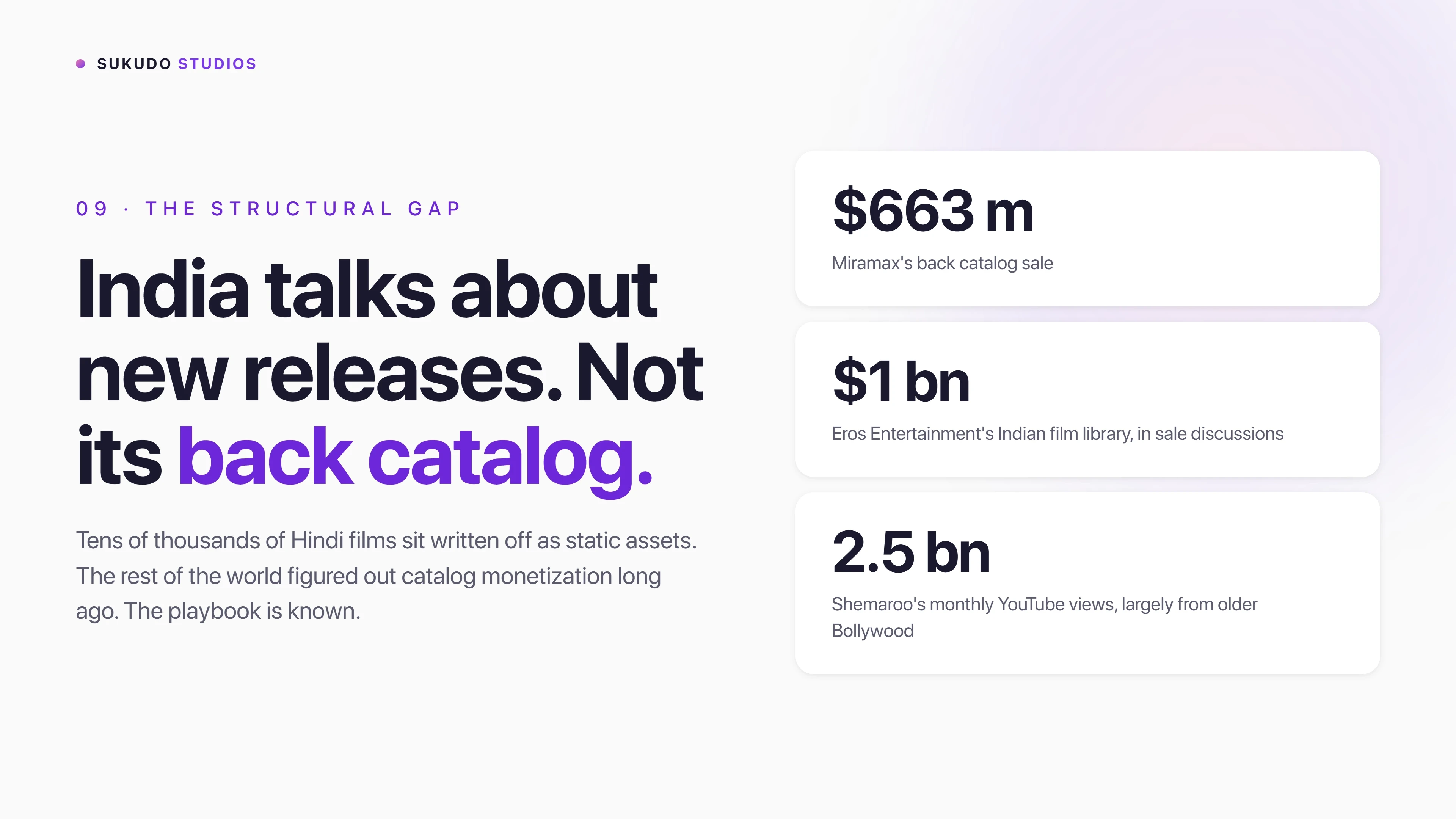
What is not normal is how little the Indian film industry talks about its own back catalog. Tens of thousands of Hindi-language films sit in libraries across the country with rights-holders who have long since written them off as static assets, earning trailing revenue from occasional television reruns and diaspora streaming plays.
This is a structural blind spot. And it is directly responsible for a systemic under-monetization of the single most valuable content library in Asian entertainment.
The rest of the world figured this out long ago. Hollywood studios have entire divisions dedicated to catalog monetization, Miramax's back catalog was sold for $663 million; Eros Entertainment's Indian film library was floated in $1 billion sale discussions; Shemaroo's YouTube empire generates 2.5 billion monthly views largely from older Bollywood songs and films. The value is real. The playbook is known.
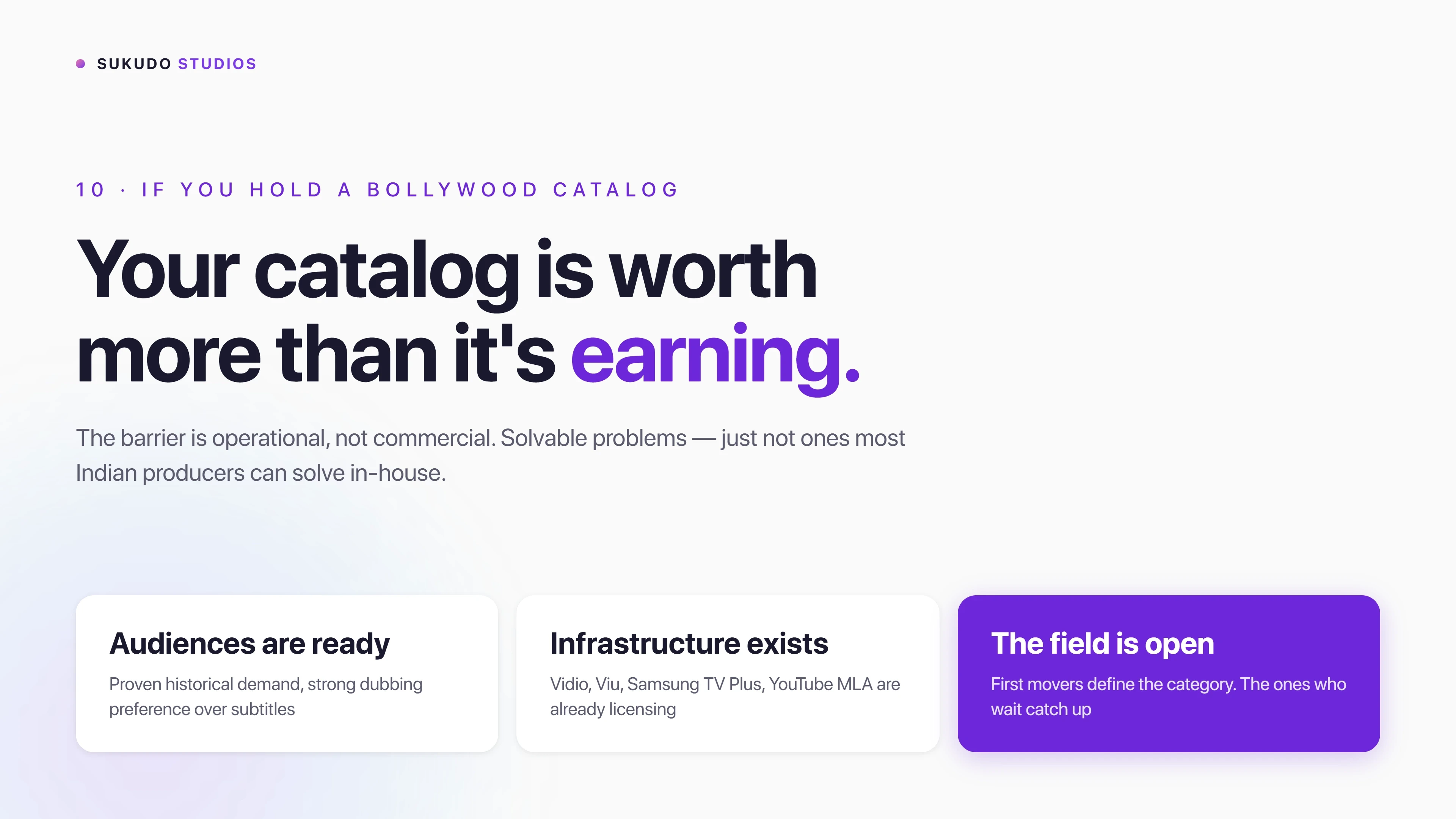
What has been missing, until recently, is the localization infrastructure to activate this value in the specific markets where it has the highest resonance. Southeast Asia is the most obvious of those markets proven historical demand, existing distribution rails, strong dubbing preference over subtitling, near-perfect genre fit with local drama consumption habits.
The client behind this project saw the gap. They acted on it. Rishtey is Phase One of what will become a much larger initiative, and it is likely, we suspect, the beginning of a broader shift in how Indian rights-holders think about their catalogs.
The producers who move first will define the category. The ones who wait will be catching up.
Let's Look at Your Catalog
If you're a producer, rights aggregator, distributor, OTT platform, or FAST channel operator with a Bollywood library, or interest in one here is a concrete offer.
Send us your title list. We'll come back to you with a shortlist.
Sukudo Studios will conduct a no-cost catalog opportunity assessment, reviewing your library against genre-fit criteria for Southeast Asian markets, era resonance, distribution suitability, and dubbing cost efficiency. You'll receive a prioritised shortlist of titles with the highest activation potential, along with our view on which languages and which distribution channels to target first.
No obligation. No pressure. Just a straightforward look at what your catalog could be earning that it currently isn't.
If you'd rather have a conversation before sharing catalog details, completely reasonable - book a discovery call with our team and we'll walk you through the economics for your specific situation.