
India's screens have quietly rewritten the entertainment rulebook. In 2025, digital media overtook television for the first time to become the single largest segment of a media and entertainment sector now worth ₹2.78 trillion. Riding that shift is a two-minute, vertical, cliffhanger-driven format almost nobody had heard of three years ago- the micro-drama- and a cluster of platforms now moving toward the public markets. This case study maps the micro-drama players preparing to IPO, the market numbers behind the momentum, the expansion moves of the past year, and the setbacks the sector has faced.
What is a micro-drama?
A micro-drama is a serialized fiction format built for mobile: episodes run 60 seconds to 2 minutes, are shot in vertical (portrait) orientation, and each end on a cliffhanger designed to pull the viewer into the next episode. A full series can run 50-plus episodes, monetized through episode-unlock micro-payments, subscriptions and advertising- and it has become the fastest-growing vertical in India's entertainment economy.

How big is India's media & entertainment market in 2026?
India's media and entertainment (M&E) sector grew 9% year-on-year to reach ₹2.78 trillion (about US$30 billion) in 2025, according to the FICCI-EY Media & Entertainment Report 2026, which projects the sector will reach ₹3.3 trillion by 2028. The structural story is the one that matters for anyone eyeing an IPO: digital media crossed the ₹1 trillion mark for the first time and overtook television as the largest segment, while digital advertising rose 26% to ₹947 billion- nearly two-thirds of all ad revenue.
Two data points frame the opportunity public-market investors are pricing in:
India's total time spent on video rose to 32 billion hours in 2025.
In-app purchases nearly tripled- from US$31 million in 2022 to US$97 million in 2025- the clearest signal that Indian audiences will now pay to unlock content.
How fast is the micro-drama market growing?
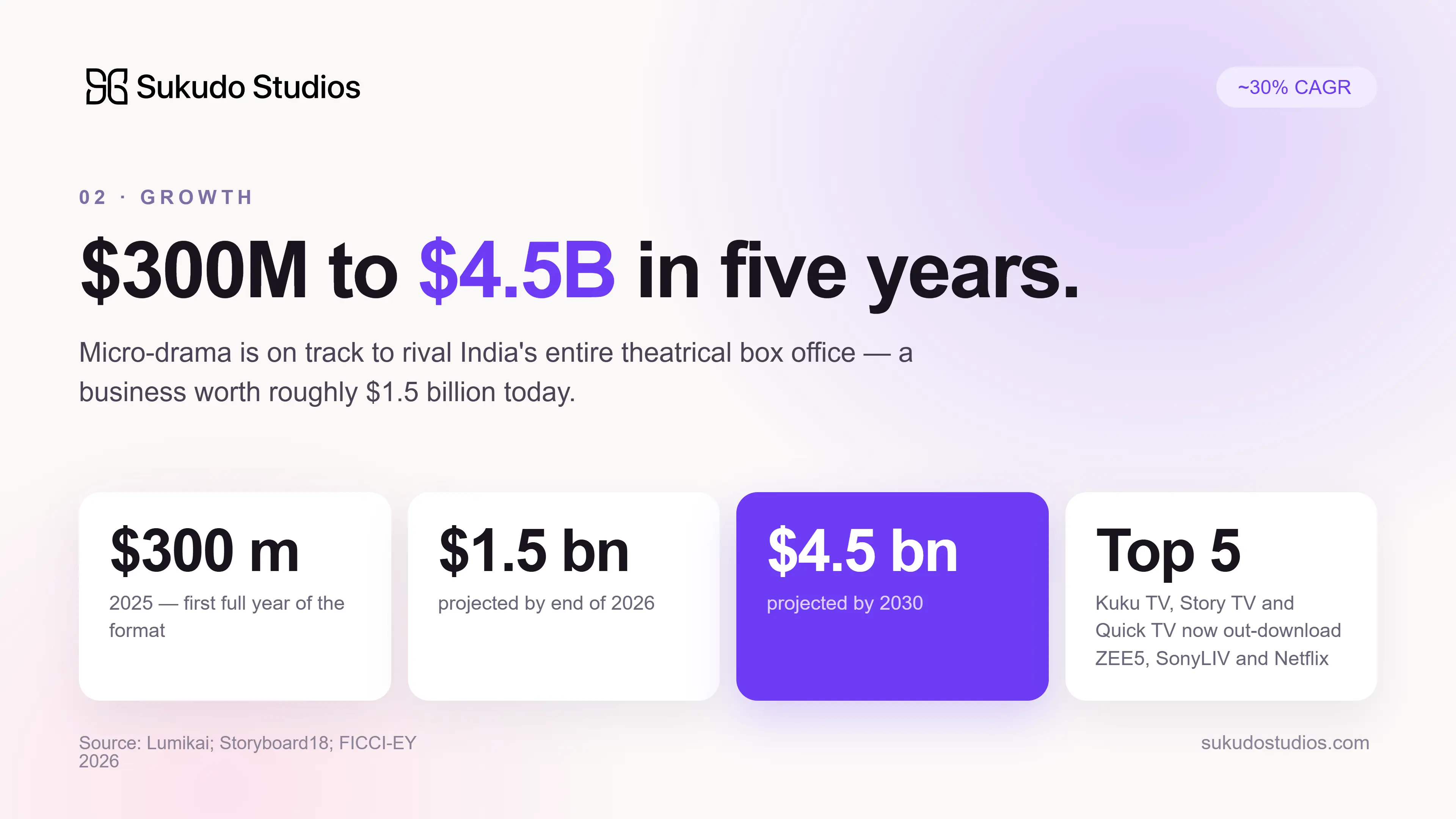
This is the number driving the IPO interest. India's micro-drama market reached roughly US$300 million in its first year (2025), according to venture firm Lumikai, and is projected to reach US$4.5 billion by 2030 at a compound annual growth rate of around 30–31%, with a further reading (via Storyboard18, citing Lumikai) projecting the market could scale to US$1.5 billion by the end of 2026. For context, India's entire theatrical box office is worth roughly US$1.5 billion, meaning micro-drama is on track to rival the cinema business within a handful of years.
The category has already broken into the mainstream. According to the FICCI-EY 2026 report, three micro-drama apps- Kuku TV, Story TV and Quick TV, have entered India's top five most-downloaded video streaming apps, ranking ahead of established OTT players like ZEE5, SonyLIV and Netflix.
Which micro-drama platforms are heading to IPO- and where do they stand?
Two dedicated micro-drama operators are furthest along the path to a public listing, at different stages. A third case, an adult-focused streaming platform, is included as a cautionary example of how regulatory risk can derail an IPO in this broader space.
Kuku Technologies (Kuku FM & Kuku TV)- the micro-drama flagbearer
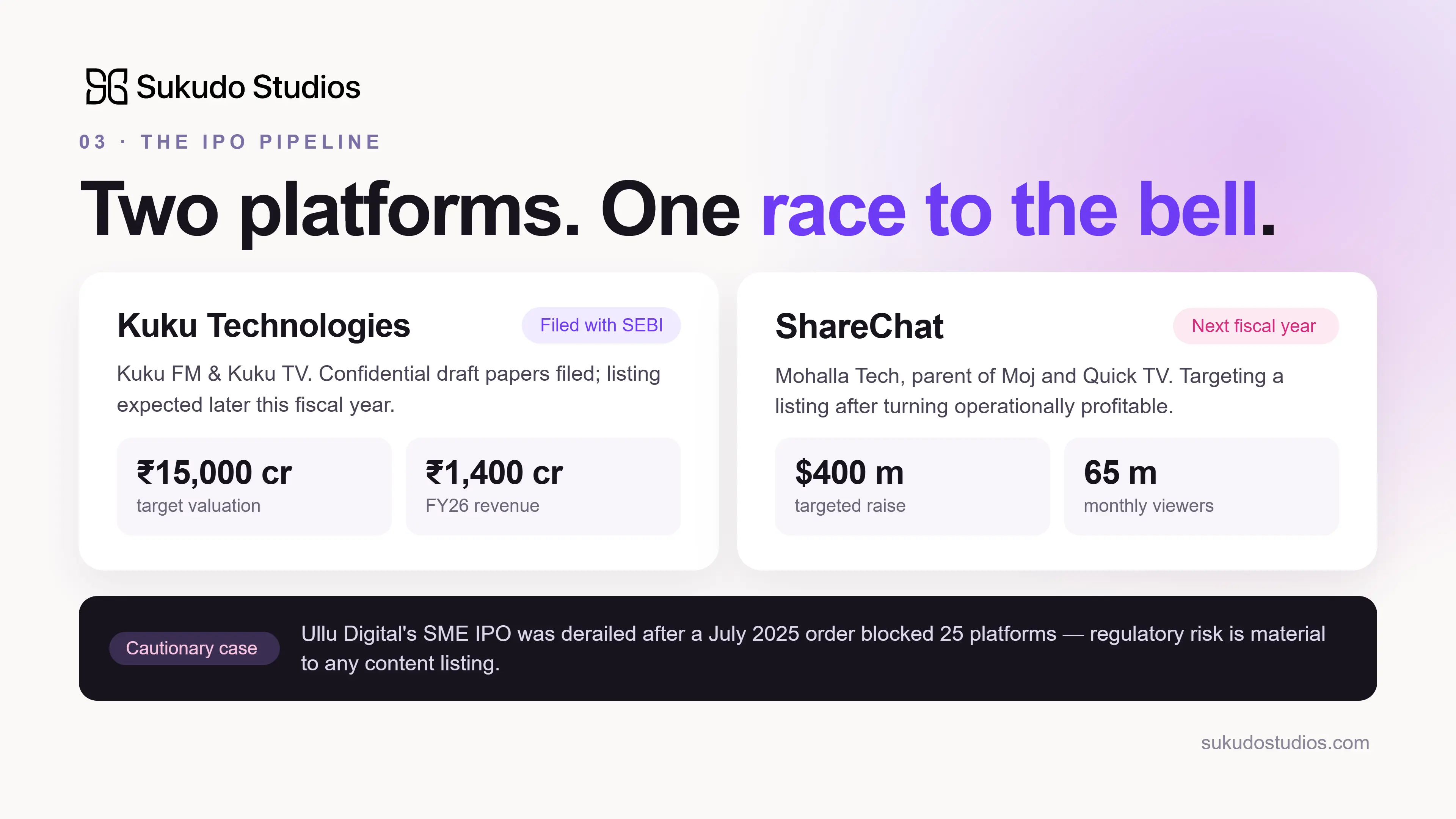
Kuku Technologies, the company behind vernacular audio platform Kuku FM and micro-drama app Kuku TV, has confidentially filed draft papers with SEBI for an IPO, according to reporting by Entrackr and Moneycontrol citing people familiar with the matter. The company is reported to be looking to raise ₹2,500–3,500 crore at a targeted valuation of around ₹15,000 crore (approximately US$1.8 billion), with a listing expected later in the fiscal year. Founded in 2018 by IIT alumni Lal Chand Bisu, Vinod Kumar and Vikas Goyal, Kuku operates across audio, micro-drama and edutainment, and reports over 10 million paying subscribers and more than 400 million cumulative downloads across its platforms.
Micro-drama is central to the company's growth story. Kuku TV, launched in late 2024, releases over 150 original shows a month and has crossed 200 million downloads; it was named Best New Short Drama App at the Sensor Tower APAC Awards 2025. In early 2026 the company launched India's first slate of AI-assisted micro-dramas, part of a strategy to lower production costs and increase output. Reported financials point to rapid scaling: revenue is reported to have grown several-fold to around ₹1,400 crore in FY26, from roughly ₹240 crore the prior year, while the company recorded a net loss of ₹153 crore in FY25 as it invested heavily in marketing and content. As with any high-growth, pre-profit platform, the key questions ahead of a listing are the durability of that revenue growth and the path to sustained profitability- factors the eventual prospectus will clarify.
ShareChat (Mohalla Tech) the turnaround story
The parent of ShareChat, short-video app Moj and micro-drama platform Quick TV is targeting an IPO to raise up to US$400 million (around ₹3,815 crore), planned for the next fiscal year after turning operationally profitable in Q1 FY27, according to a Bloomberg interview with CFO Manohar Charan. Micro-drama is the engine of the turnaround: ShareChat reports reaching about 65 million monthly micro-drama viewers, nearly two-thirds of India's audience for the format, who watch more than 700 million episodes every day, with Quick TV at around 3 million subscribers. The recovery follows several years of restructuring and cost discipline after the 2021-22 funding boom ended, and the company reports revenue crossing ₹1,000 crore with an annualized run rate near ₹1,400 crore.
Ullu Digital - a cautionary tale on regulatory risk
Ullu, an adult-focused streaming platform rather than a micro-drama specialist, is included here because its experience illustrates the regulatory risk facing content platforms pursuing an IPO. Ullu filed its DRHP with the BSE SME platform in February 2025 for a
₹135–150 crore raise, which would have been the largest-ever IPO in India's SME segment. In July 2025 the Ministry of Information & Broadcasting ordered internet service providers to block 25 platforms including Ullu over obscene and unlawful content, after the IPO had already been paused following objections from a self-regulatory body and the National Commission for Protection of Child Rights. The episode is a reminder that content compliance is a material factor in any streaming-sector listing.
Who else is shaping the micro-drama field?
Beyond the two IPO-bound names, a fast-widening field of dedicated platforms, well-funded newcomers, global revenue leaders and deep-pocketed streaming giants is defining how competitive this category has become. Four stand out.
Story TV - the fast-scaling dedicated platform
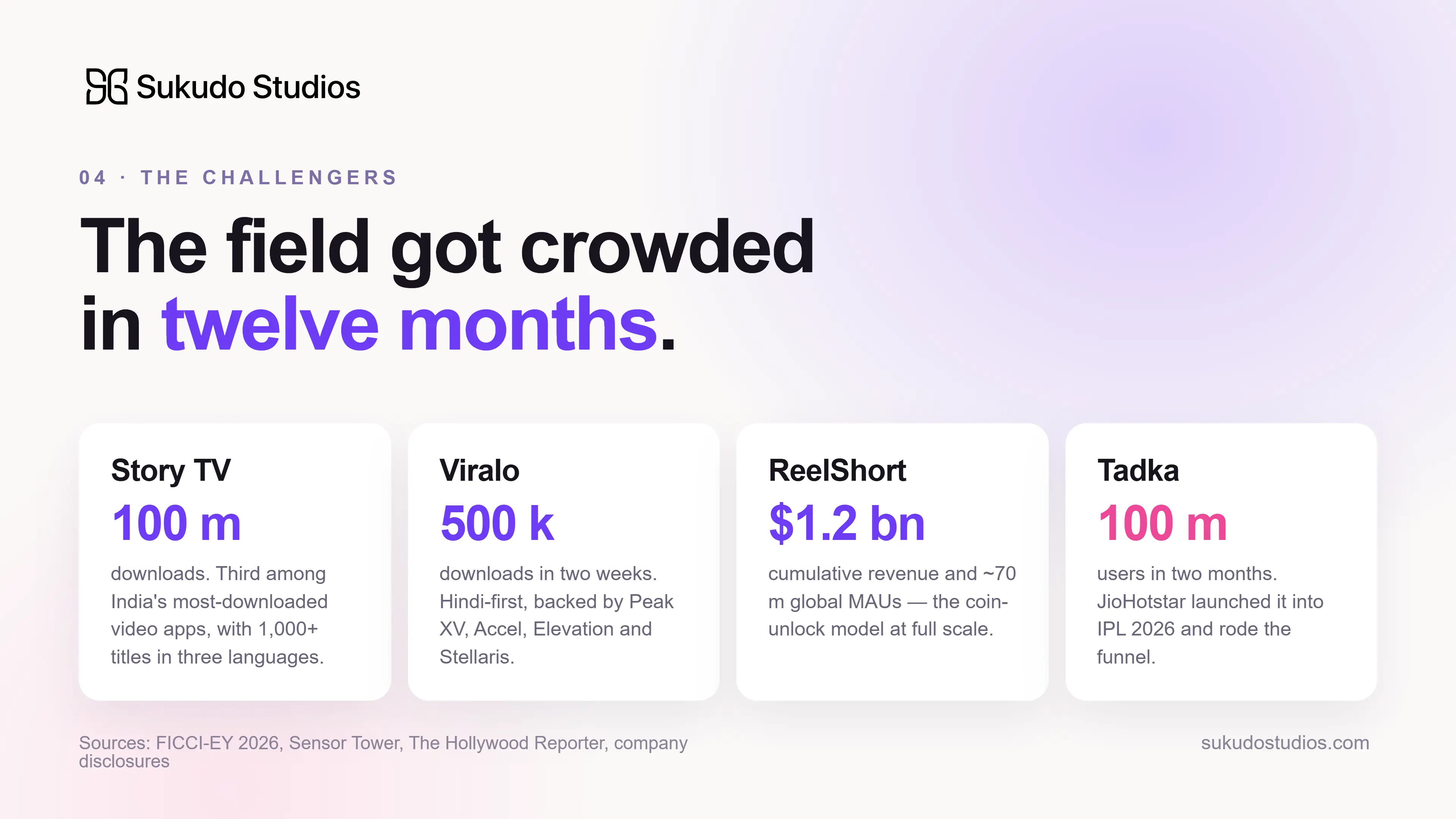
Story TV has emerged as one of India's largest dedicated micro-drama platforms. Per the FICCI-EY 2026 report it ranks third among the country's top five most-downloaded video streaming apps, ahead of ZEE5, SonyLIV and Netflix - and has crossed 100 million downloads. Founder and CEO Saurabh Pandey has said the platform reached 8 crore (80 million) users and a library of over 1,000 micro-dramas across three languages within nine months. Its strategy leans heavily on partnerships: Story TV has tied up with Balaji Telefilms, Zee Entertainment Enterprises and Applause Entertainment to bring legacy IP and production expertise into the vertical format.
Viralo (by Rigi) - the well-backed newcomer
Launched in July 2025 by creator-economy company Rigi, Viralo is a Hindi-first micro-drama platform built for mobile-native audiences across metros and tier-2 towns, spanning thriller, revenge, suspense, romance and comedy. It scaled quickly, crossing 500,000 downloads within two weeks of launch and climbing into the top 20 free apps on Google Play. Viralo is notable for its investor backing, which includes Ramakant Sharma (Livspace), Kunal Shah (CRED), Amit Agarwal (NoBroker) and Tanmay Bhat, alongside VCs such as Stellaris, Peak XV, Elevation Capital and Accel. The platform has signaled plans to add 100+ new series and lean on AI-powered recommendations to scale.
ReelShort - the global revenue leader
ReelShort, from Crazy Maple Studio (COL Group), is one of the world's highest-grossing micro-drama apps, with cumulative revenue estimated at over US$1.2 billion since launch and around 70 million monthly active users globally as of Q1 2026, according to Sensor Tower and industry trackers. Its model is built on coin-unlock micro-payments optimized for high-ARPU Western markets, where per-download revenue is several times higher than in India. In the Indian market ReelShort remains a smaller player by local users- the Hindi-first incumbents lead on language-specific content- but its scale, catalogue and content flywheel make it a significant competitive reference point, particularly as global platforms weigh deeper localization into Indian languages.
Tadka (JioHotstar) - the streaming giant's entry
Tadka is the micro-drama vertical launched by JioHotstar (JioStar, the Viacom18–Disney Star joint venture) on 3rd April 2026, debuting with more than 100 original titles of 60–90-second episodes. Its defining advantage is distribution: Tadka launched during IPL 2026, using cricket's enormous audience as an acquisition funnel, and crossed 100 million users within roughly two months, per company disclosures reported by The Hollywood Reporter. It runs an ad-supported model and is being used by JioStar as a testbed for shoppable content and AI-generated micro-dramas. Tadka is a feature within a larger platform rather than an IPO candidate itself, but its rapid scale illustrates how the deepest-pocketed incumbents can enter the category and reach scale almost overnight.
What expansion moves reshaped the market in the past year?
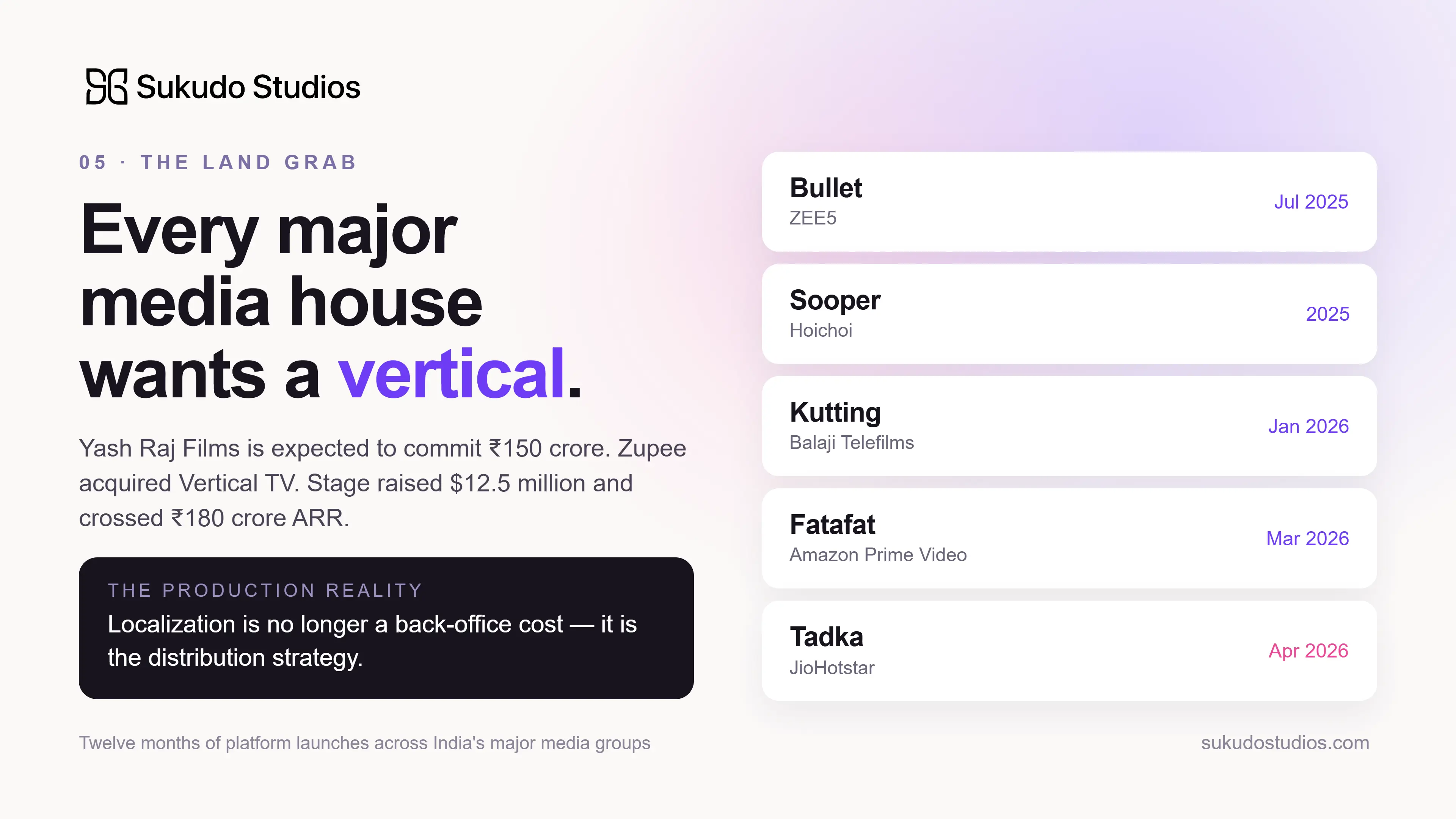
The past twelve months saw the format go from fringe experiment to a land grab involving nearly every major media house in India:
ZEE5 launched Bullet (July 2025)
Balaji Telefilms launched Kutting (January 2026)
Amazon Prime Video launched Fatafat (March 2026)
MX Player expanded its short-form vertical slate (2025–26)
Hoichoi launched Sooper, its Hindi micro-drama platform
Legacy production houses joined too - Yash Raj Films is expected to invest around ₹150 crore in micro-dramas, and Sameer Sippy Productions licensed classic Bollywood IP for adaptation into vertical series for the US platform ReelShort. Consolidation has begun as well: gaming company Zupee acquired micro-drama startup Vertical TV. Beyond the IPO pipeline, regional OTT Stage raised US$12.5 million in Series B, crossed ₹180 crore ARR with 4.4 million paying households, and is expanding into Awadhi, Maithili and Magahi- a strong 'next in line' to watch.
Underpinning all of it is a production reality that makes this scale possible: these are multilingual, dub-and-subtitle-heavy operations. The FICCI-EY report projects vernacular content will comprise the majority of OTT production, and platforms are racing to localize a single title across a dozen languages before release. Localization is no longer a back-office cost- it is the distribution strategy.
What setbacks has the sector faced in the past year?
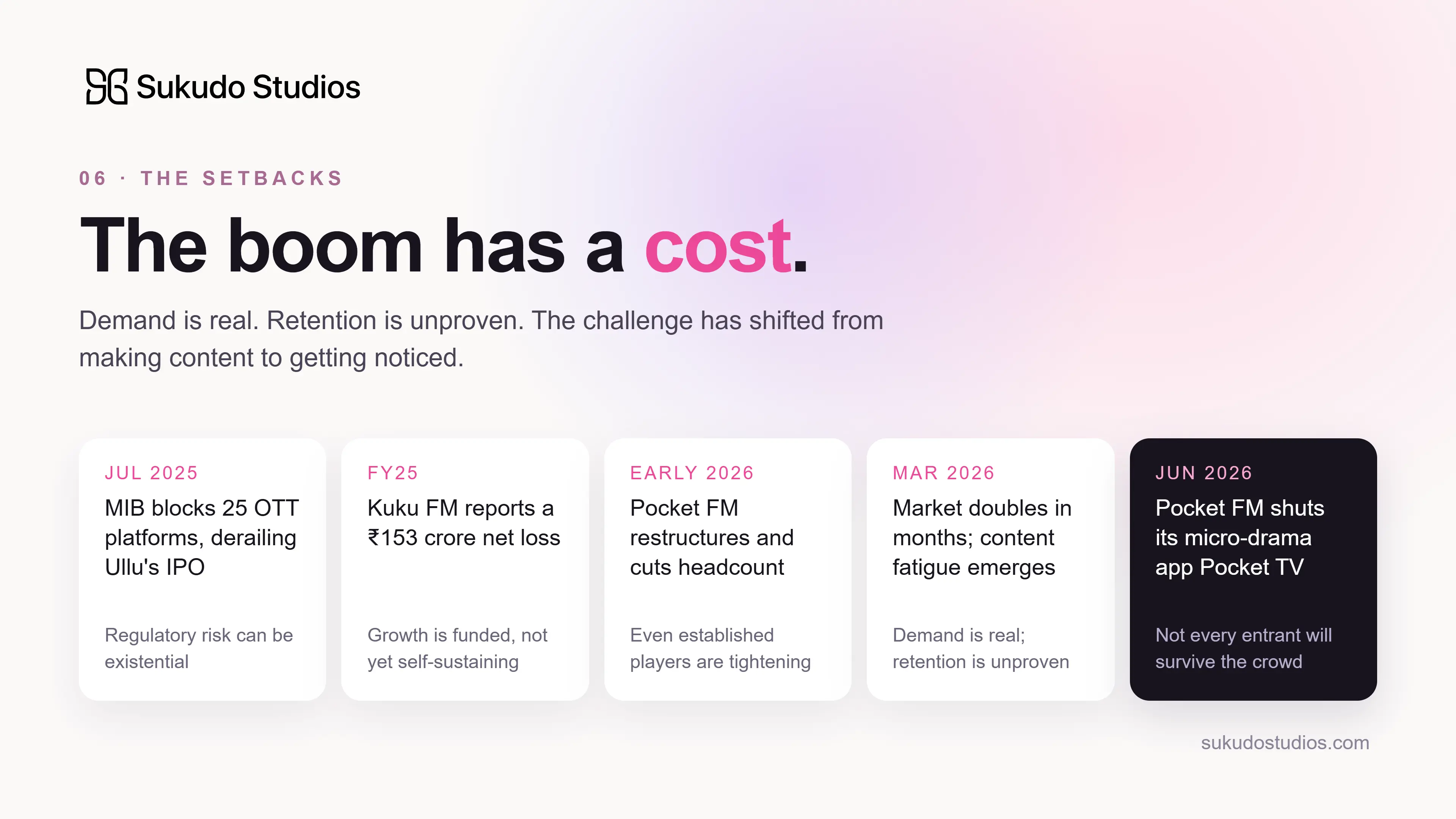
For all the momentum, the last twelve months supplied a sobering counter-narrative. The market is booming but profitability remains elusive, and the challenge has visibly shifted from creating content to getting noticed in an increasingly crowded field.
Date | Event | What it signals |
Jul 2025 | MIB blocks 25 OTT platforms, derailing Ullu's IPO | Regulatory risk can be existential |
FY25 | Kuku FM reports a ₹153 crore net loss amid heavy marketing spend | Growth is being funded, not yet self-sustaining |
Early 2026 | Pocket FM restructures and reduces headcount | Even established players are tightening |
Mar 2026 | Market doubles to ~$260M in months; content fatigue emerges | Demand is real; retention is unproven |
Jun 2026 | Pocket FM shuts its micro-drama app Pocket TV | Not every entrant will survive the crowd |
The most telling episode is Pocket FM's exit from the format. In June 2026 the audio company shut down its micro-drama platform Pocket TV, redirecting resources to its core audio business as competition intensified. Its framing is instructive for the whole sector: co-founder Rohan Nayak has argued that the real challenge in micro-drama is long-term retention, not initial acquisition. Whether the IPO-bound platforms can convert readily-acquired viewers into retained, paying users is the question that will separate the winners from the also-rans.