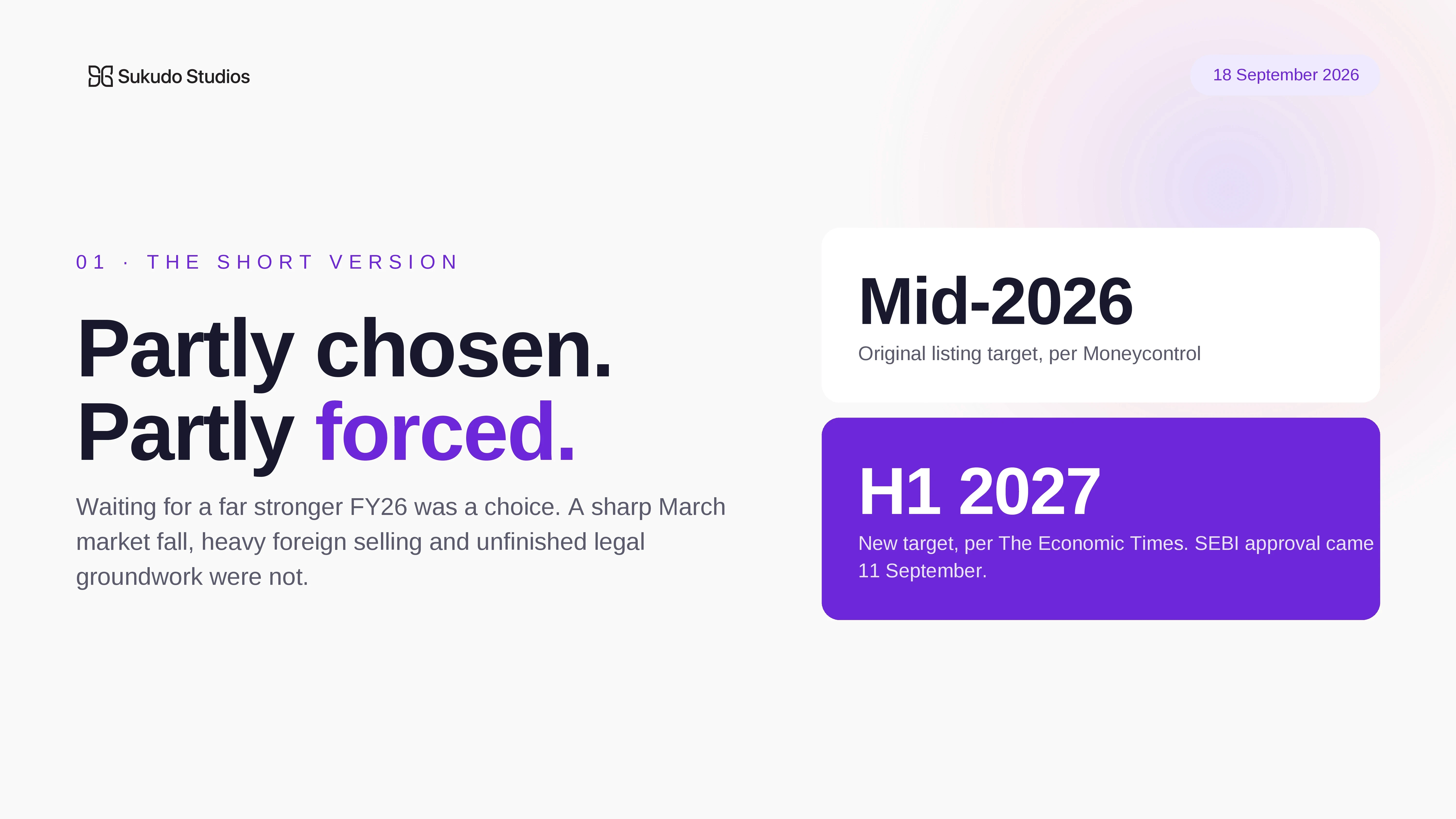
Kuku Technologies' planned stock market debut. According to Moneycontrol (via Outlook Business, December 2025), Kuku aimed to list by mid-2026; according to The Economic Times and Indian Startup News (September 2026), it now targets the first half of 2027.
Kuku, the company behind Kuku FM and the micro-drama app Kuku TV, planned to list by the middle of 2026, according to Moneycontrol (via Outlook Business). According to Entrackr and BestMediaInfo, it filed its papers only in June and won SEBI approval on 11 September. This study looks at why, and reads Kuku's journey alongside the NSE and Jio IPOs and a difficult year for Indian stocks.
₹2,500–3,500 cr Proposed Kuku IPO size. According to BestMediaInfo and Inc42, it is seen that estimates suggest it to be in this range | ~₹15,000 cr Target valuation. According to The Economic Times, it is seen that estimates suggest it to be about ₹15,000 crore, about 3× the last private round |
−10.9% Nifty 50 change in 2026 to 17 September; our calculation from official closes reported by Upstox and Business Standard | ₹2.37 lakh cr Net foreign investor selling of Indian shares in 2026 to 11 September, according to NSDL data reported by Angel One |
The short version
Kuku's delay was partly chosen and partly forced. According to Moneycontrol (via Outlook Business), it is seen that estimates suggest Kuku's FY26 revenue was more than ₹1,400 crore and the company was close to breakeven, almost six times the ₹242 crore of FY25 revenue shown in Registrar of Companies filings (reported by Angel One). In our reading, waiting for those results was a choice. The forced part was a sharp market fall in March 2026, heavy selling by foreign investors, and legal groundwork that was reportedly unfinished.
Kuku is not alone. According to TelecomTalk, Jio Platforms had aimed to list in the first half of 2026; according to Business Today and Kotak Neo, it filed in June and received SEBI approval on 28 August, without yet setting a date. NSE, India's largest stock exchange, filed on 17 June and, according to Groww (citing NSE's prospectus), opened its share sale on 17 September. All three filed in June, once the market had recovered from its March low. In our view, that timing is the clearest sign that the market, more than anything company-specific, set the calendar.
For the rest of the financial year to March 2027, we think the outcome of the NSE listing, the oil price, and whether foreign investors return are the three things most likely to decide whether Kuku and Jio can list on their new timetables.
How to read this study: every figure names its source. Where a source gives an estimate or relies on unnamed people, we say "according to [source], it is seen that estimates suggest it to be…". Where a figure is our own calculation, we say so.
Terms used in this study
IPO language is full of short forms. Here is what each one means in everyday words.
IPO (initial public offering)
The first time a company sells its shares to the public so they can be bought and sold on a stock exchange.
DRHP (draft red herring prospectus)
The first detailed document a company sends to the regulator before an IPO. It describes the business, its money and its risks. A "confidential" filing keeps it private until the regulator has reviewed it.
SEBI observation letter
The market regulator's go-ahead after reviewing the draft. It is permission to proceed, not a guarantee of success.
UDRHP and RHP
The updated draft (published for public comment) and the final prospectus with the price range. These come after SEBI's go-ahead.
Fresh issue and OFS (offer for sale)
A fresh issue creates new shares and the money goes to the company. An OFS is existing owners selling their shares; that money goes to them, not the company.
Nifty 50 and Sensex
The two main scorecards for Indian stocks. Each tracks the share prices of India's biggest companies.
FPI (foreign portfolio investor)
An overseas fund buying or selling Indian shares. Their flows move the market a lot.
DII (domestic institutional investor)
Indian mutual funds, insurers and pension funds. In 2026 they kept buying while foreigners sold.
Anchor, QIB, NII and retail
The groups that bid in an IPO: anchors are big funds that commit a day early; QIBs are large institutions; NIIs are wealthy individuals and firms; retail means ordinary investors.
Listing gain
How far a new share's price is above (or below) its IPO price on its first trading day.

Kuku's IPO, in detail
According to Inc42 and The Economic Times, Kuku Technologies was founded in 2018 by Lal Chand Bisu, Vikas Goyal and Vinod Kumar Meena. It runs three apps: Kuku FM for audio stories, Kuku TV for short vertical micro-dramas, and Guru for short learning. According to The Economic Times, Kuku TV launched in 2024 and has become the company's biggest source of business. According to Indian Startup News, the group had crossed 400 million app installs, 10 million paying subscribers and more than 50,000 creators by August 2026.
According to Inc42, Kuku has raised over $156 million from investors including Fundamentum, Krafton, Vertex Ventures, IFC and 3one4 Capital. Its last round, $85 million in October 2025 led by Granite Asia, was reported at a $550 million post-money valuation by The Economic Times and at about $500 million by Outlook Business and IPO Central. According to The Economic Times, this was roughly ₹4,500 crore.
How the plan unfolded
September 2023 | According to IPO Central, raises $25 million at a $185 million valuation. |
October 2025 | Raises $85 million led by Granite Asia, at a reported $500–550 million (The Economic Times; Outlook Business). According to IPO Central, early investor 3one4 Capital partly exits. |
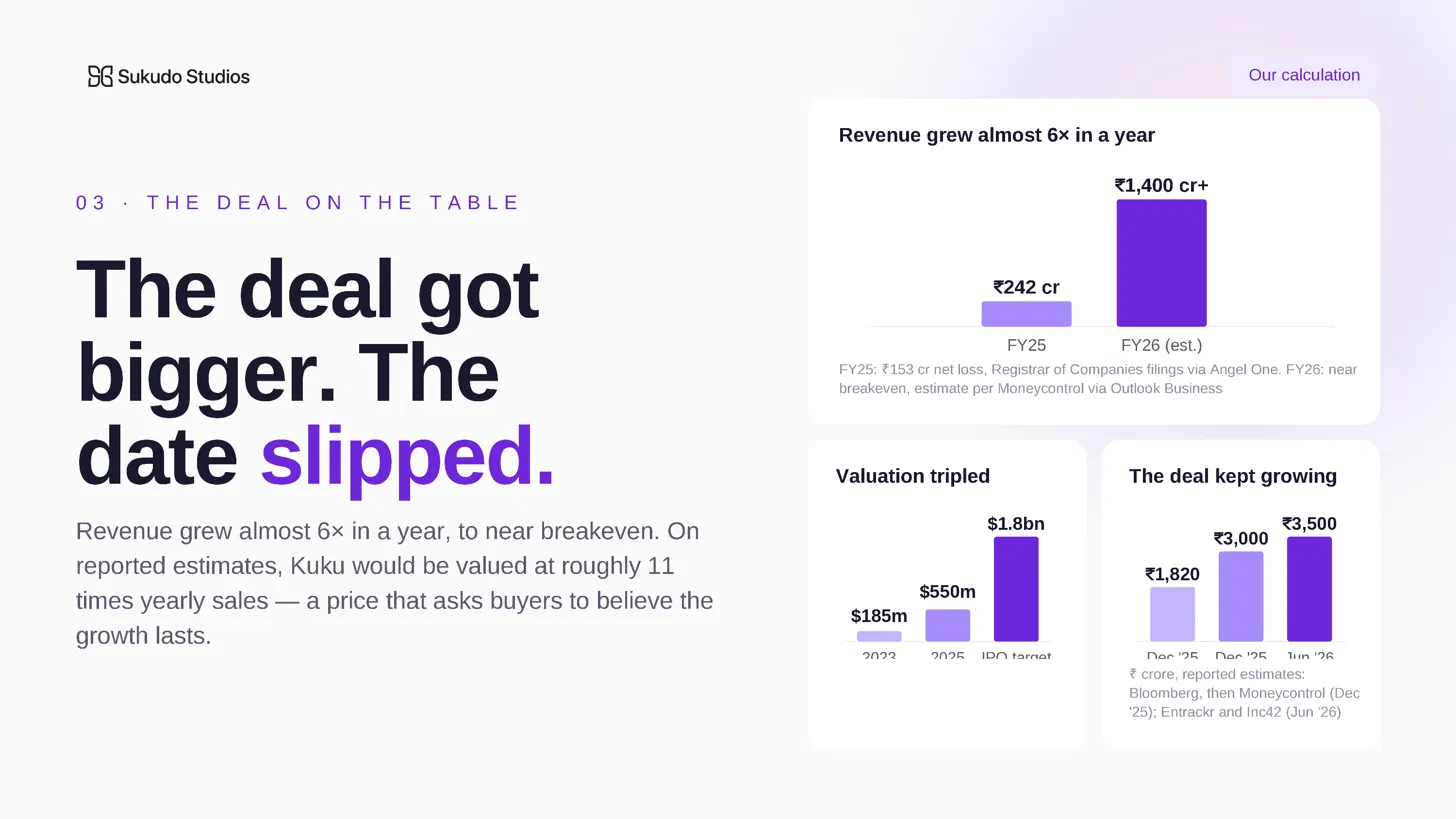
December 2025 | Bankers reported as appointed: according to Moneycontrol (via Outlook Business), Kotak, Jefferies, JM Financial and Axis; according to Bloomberg (via Inc42), Kotak, Axis and Morgan Stanley. According to Moneycontrol, the plan was to file in January–March 2026 and list by mid-2026. Estimated sizes: about $200 million (₹1,820 crore) according to Bloomberg, and up to ₹3,000 crore according to Moneycontrol. |
January–March 2026 | No filing is reported in the planned window. According to CNBC, markets fall sharply after the Iran conflict begins on 28 February. |
31 March 2026 | Financial year FY26 ends. According to Moneycontrol (via Outlook Business, June 2026), it is seen that estimates suggest Kuku's FY26 revenue was more than ₹1,400 crore. |
Early June 2026 | According to Entrackr and Outlook Business (4 June), Kuku files its draft papers confidentially with SEBI. According to these reports, it is seen that estimates suggest a size of up to ₹3,500 crore and a target valuation of about ₹15,000 crore. |
11 September 2026 | According to BestMediaInfo and Inc42, SEBI issues its observation letter, clearing Kuku to proceed. |
Late September to early October 2026 | According to The Economic Times, an updated prospectus is expected within about three weeks of approval. |
January–June 2027 | Target listing window, according to The Economic Times and Indian Startup News. |
The deal on the table
Item | What is known | Source |
Issuer | Kuku Technologies (earlier reported as Mebigo Labs Pvt Ltd) | The Economic Times; IPO Central |
Size (estimate) | ₹2,500–3,500 crore (about $261–366 million) | Inc42; BestMediaInfo (reported estimate) |
Structure | Fresh issue of new shares plus an offer for sale by existing investors; split not yet public | The Economic Times; Inc42 |
Target valuation (estimate) | About ₹15,000 crore (about $1.8 billion) | The Economic Times; Inc42 (reported estimate) |
Use of new money | Technology and AI infrastructure, content production, and expansion into new regions | Inc42 |
Bankers | Kotak Mahindra Capital, Jefferies, JM Financial, Axis Capital | The Economic Times |
Route | Confidential pre-filing: SEBI reviews privately first, then the public sees an updated draft | Entrackr; The Economic Times |
Status (18 Sep 2026) | SEBI approval received 11 September; updated prospectus pending; listing aimed at H1 2027 | BestMediaInfo; The Economic Times |
What public-market investors will look at
According to The Economic Times, it is seen that estimates suggest a valuation of about ₹15,000 crore; according to Moneycontrol, it is seen that estimates suggest FY26 revenue above ₹1,400 crore. On those two estimates, our own estimates suggest Kuku would be valued at roughly 11 times its yearly sales. Buyers will want proof that this growth can last and turn into steady profit. The questions they will ask are predictable: how much Kuku spends on marketing to win each paying user, how long those users stay, how much content costs, and how the AI production studio changes those costs. According to Whalesbook, the path to profit is the main thing investors will watch, because content-heavy apps usually need heavy, continuing spending to win and keep users.
Competition is the other question. According to Inc42, Kuku TV competes with Pocket FM, Flick TV, ReelSaga and Miniplix, and with large streaming services such as Amazon, JioHotstar and Zee5. We are not aware of any listed micro-drama company in India to compare it with, so investors must be taught the category from scratch.
Why the IPO was delayed
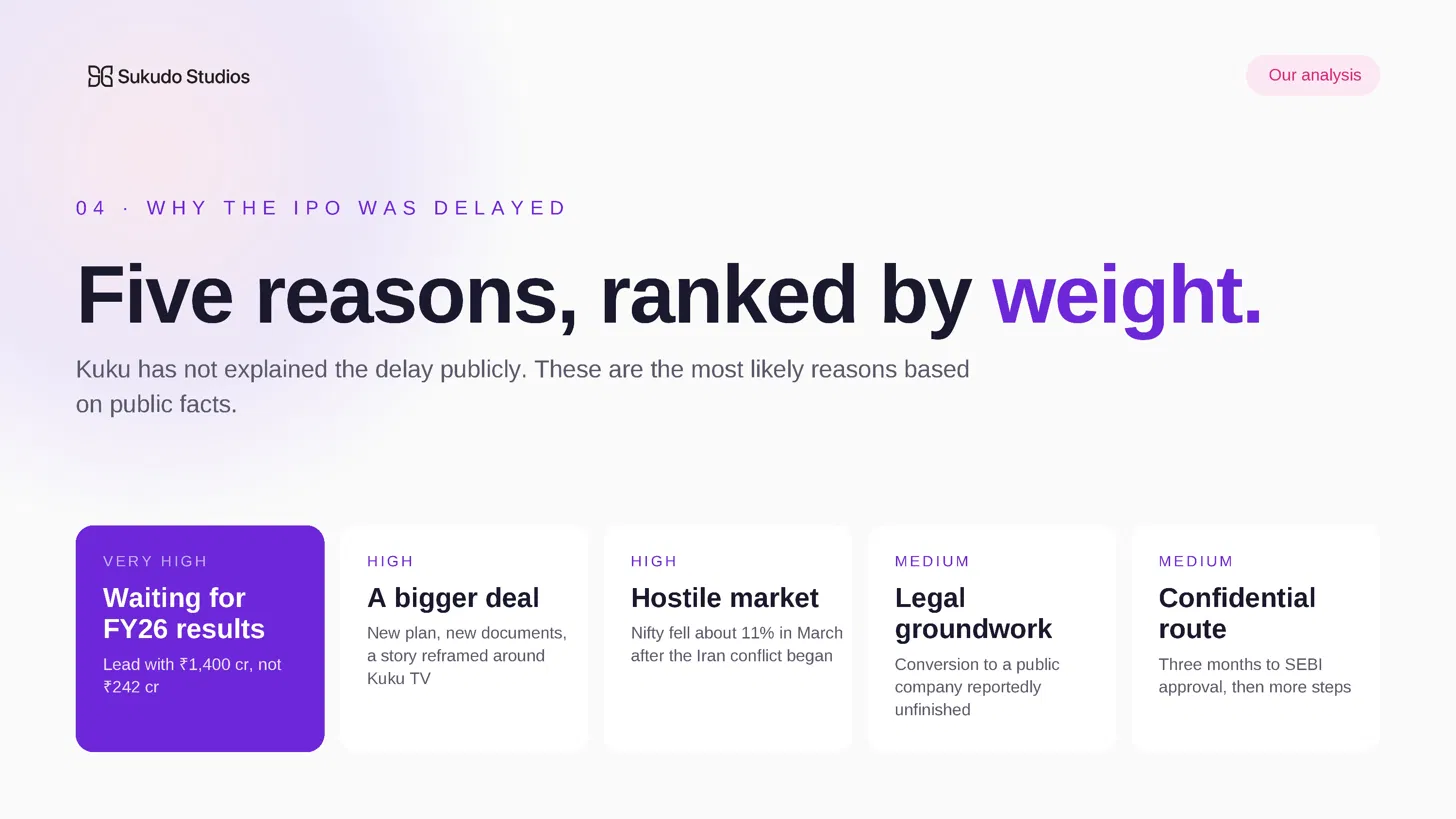
Kuku has not explained the delay publicly. These are the most likely reasons based on public facts, ranked by how much weight we think each carries.
Waiting for FY26 results Weight: very high | According to Registrar of Companies filings reported by Angel One, FY25 revenue was ₹242 crore with a net loss of ₹153 crore. According to Moneycontrol (via Outlook Business, June 2026), it is seen that estimates suggest FY26 revenue was over ₹1,400 crore and the company was close to breakeven. Filing after 31 March let Kuku lead with the far stronger year. This reason is our analysis; Kuku has not confirmed it. |
A bigger deal needed a rebuilt plan Weight: high | According to Bloomberg (via Inc42), estimates in December 2025 put the IPO at about ₹1,820 crore; according to Inc42 and BestMediaInfo, estimates now suggest up to ₹3,500 crore. The target valuation reported by The Economic Times is about three times the last round. That means new documents, new investor conversations and a stronger story, especially one reframed around Kuku TV. This reason is our analysis. |
The market turned hostile Weight: high | According to CNBC, the Iran conflict from 28 February hit Indian shares, and PhonePe halted its listing. According to Kotak Neo, the Nifty closed at 22,331.40 on 30 March, the last trading day of FY26; our calculation, using this close and an index-fund estimate for end-February, suggests a fall of about 11% in March. According to BW Businessworld, more than half of 2025's new listings were trading below their IPO price. Filing into that market at a high valuation would have been poor timing. |
Legal groundwork was unfinished Weight: medium | According to a market-news summary published by Multibagg, one report noted in early 2026 that Kuku had not yet converted from a private limited company to a public company, which Indian listing rules require. We could not confirm this in a primary source. According to IPO Central and The Economic Times, the parent's name has also changed from Mebigo Labs to Kuku Technologies. |
The confidential route has more steps Weight: medium | According to Entrackr and BestMediaInfo, SEBI took about three months (June to 11 September) to approve. After that come the updated draft, a public comment period, the final prospectus and the share sale itself. Once filing moved to June, a July listing was not possible. |

Three big IPOs, one pattern
Kuku is easier to understand next to two much larger names that were also aiming at 2026: NSE and Jio Platforms. Their plans and their actual dates line up closely, which tells us the market, not company-specific trouble, set the calendar.
The June filing wave
According to Entrackr, Kuku filed in early June (reported on 4 June); according to Finnovate and Swastika, NSE filed on 17 June; and according to Business Today, Jio filed on 19 June. That is three of India's most watched IPOs inside one month, each expected earlier. In our view, the most likely common trigger was the market's recovery from its 30 March low, together with full-year FY26 accounts that each company could now put in its papers.
NSE: the test case for everyone else
According to Finnovate, NSE's IPO had been stuck for nearly a decade over the co-location case, in which some brokers were alleged to have received faster access to its data feed. According to Swastika, SEBI gave its no-objection on 30 January 2026; NSE filed on 17 June. According to Startup Fortune (citing Reuters via Moneycontrol), the Supreme Court dismissed SEBI's appeals in the related cases on 3 September. According to IANS, SEBI approved the draft on 4 September. According to Groww, citing NSE's prospectus, the share sale runs from 17 to 21 September, with listing on BSE tentatively on 24 September.
According to Groww, the issue is entirely an offer for sale of ₹22,561.57 crore (12.64 crore existing shares); according to Kotak Neo, this was cut from the 14.89 crore shares first planned. Sellers include SBI and Canada Pension Plan Investment Board. The price range is ₹1,700–1,785 per share, and according to Business Today, NSE is worth about ₹4.42 lakh crore at the top of the range. According to ICICI Direct, that is about 40.8–42.9 times FY26 earnings. According to Business Today and Upstox, NSE placed ₹6,746 crore with anchor investors including LIC, Norway's and Abu Dhabi's sovereign funds, Fidelity and Goldman Sachs. According to Anand Rathi, NSE lists on BSE because an exchange cannot list on itself.
Jio: the giant still in the queue
According to TelecomTalk, Mukesh Ambani told shareholders in August 2025 that Jio aimed to list in the first half of 2026. According to Business Today, Jio filed its draft on 19 June 2026, the day of Reliance's annual meeting. According to PTI (via HDFC Sky), the issue is a fresh issue of up to 27 crore shares; according to exchange4media, that is about 2.9% of the company after the issue. According to Kotak Neo, SEBI cleared it on 28 August, and it is seen that estimates suggest the issue will raise around ₹37,700 crore, which would make it India's largest IPO, ahead of Hyundai India. According to Outlook Business, ₹27,500 crore is earmarked to repay debt at Reliance Jio Infocomm. According to Business Today, Jio reported FY26 revenue of ₹2.22 lakh crore and net profit of ₹30,064 crore. No listing date has been announced.
Why this matters for Kuku. Jio is likely to reach the market before Kuku's H1 2027 window. A very large IPO draws in a lot of investor money at once, and how NSE and Jio trade after listing will shape the mood Kuku walks into. Strong debuts would help Kuku; weak ones would make investors more cautious about new listings.
How healthy is the Indian market?
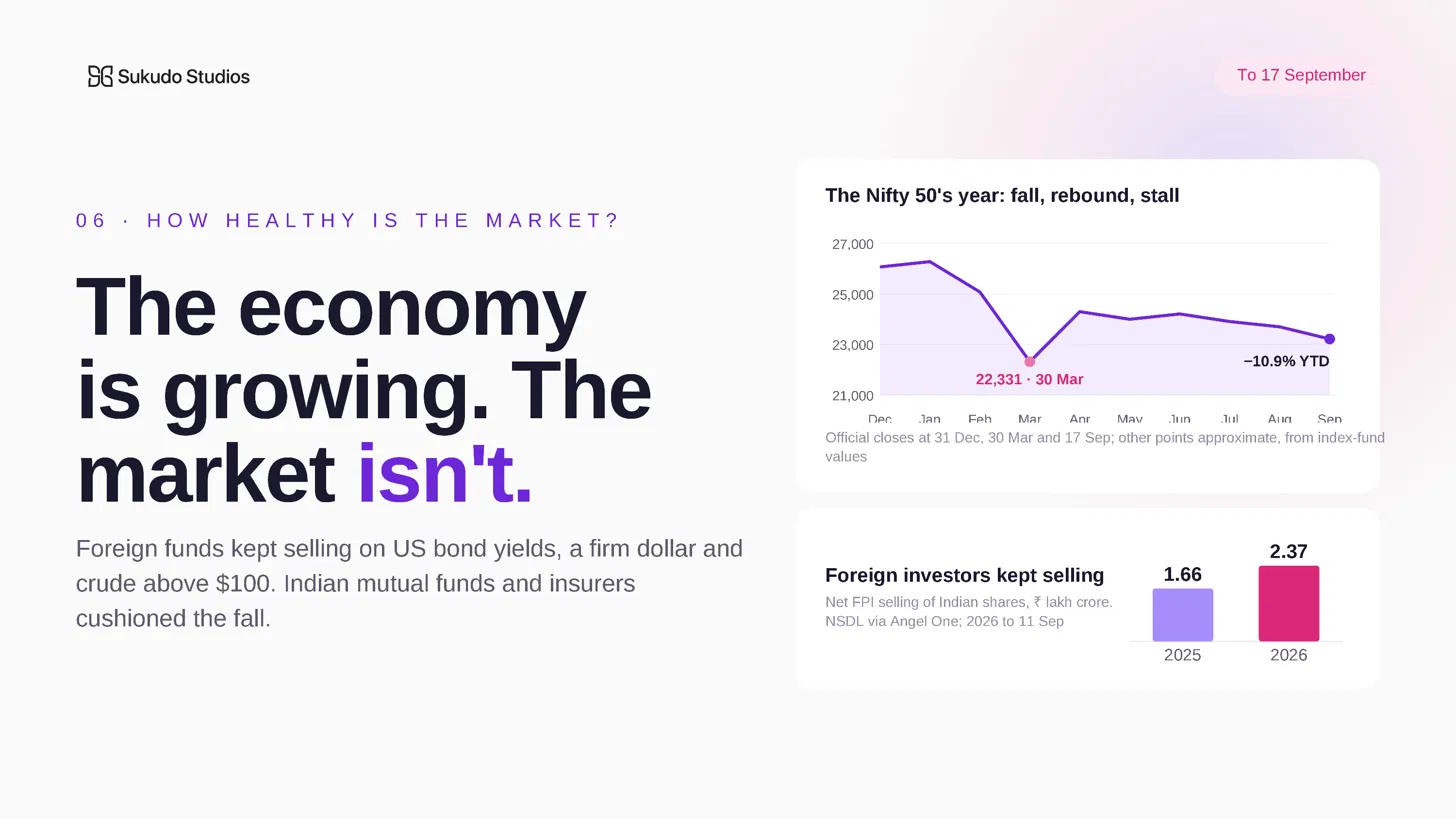
India's economy is growing fast; its stock market is not. According to Navia, GDP grew 7.8% in April–June, ahead of the RBI's 7% estimate, and GST collections were ₹1,99,853 crore in August after ₹2.11 lakh crore in July. Yet, by our calculation from official closes (Upstox for 31 December; Business Standard for 17 September), the Nifty 50 is 10.9% lower than where it started the year.
Reading the market in four signals
Direction. Based on index-fund data from Advisorkhoj, our estimates suggest the index fell about 15% from its early-January peak to the 30 March close of 22,331.40 (Kotak Neo). The April rebound recovered roughly half of that, and the market has drifted since. Sources disagree on the exact FY26 return (Finnovate reports −3.27%; Goodreturns says close to 4%), but all agree it ended in the red. By our calculation from official closes, FY 2026-27 is up about 4% so far, mainly because it started from the March low.
Who is buying. According to NSDL data reported by Angel One, foreign funds sold ₹2.37 lakh crore of Indian shares in 2026 up to 11 September, already more than the ₹1.66 lakh crore sold in all of 2025. According to Angel One, rising US bond yields, a firm dollar and crude oil above $100 a barrel were the main reasons. According to India TV and Business Standard, the US Federal Reserve raised interest rates on 16 September. According to Navia and ScanX, Indian mutual funds and insurers kept buying, which cushioned the fall.
Breadth. According to Navia, in August the Nifty 50 slipped while the midcap and smallcap indices rose for a fifth straight month. According to Navia, metals and PSU banks gained while FMCG (everyday consumer goods) fell over 6% on rising input costs.
Policy. According to Navia, the RBI has held its repo rate at 5.25% for four meetings, raised its FY27 growth forecast to 6.7% and trimmed its inflation forecast to 5%. It meets next on 5–7 October.
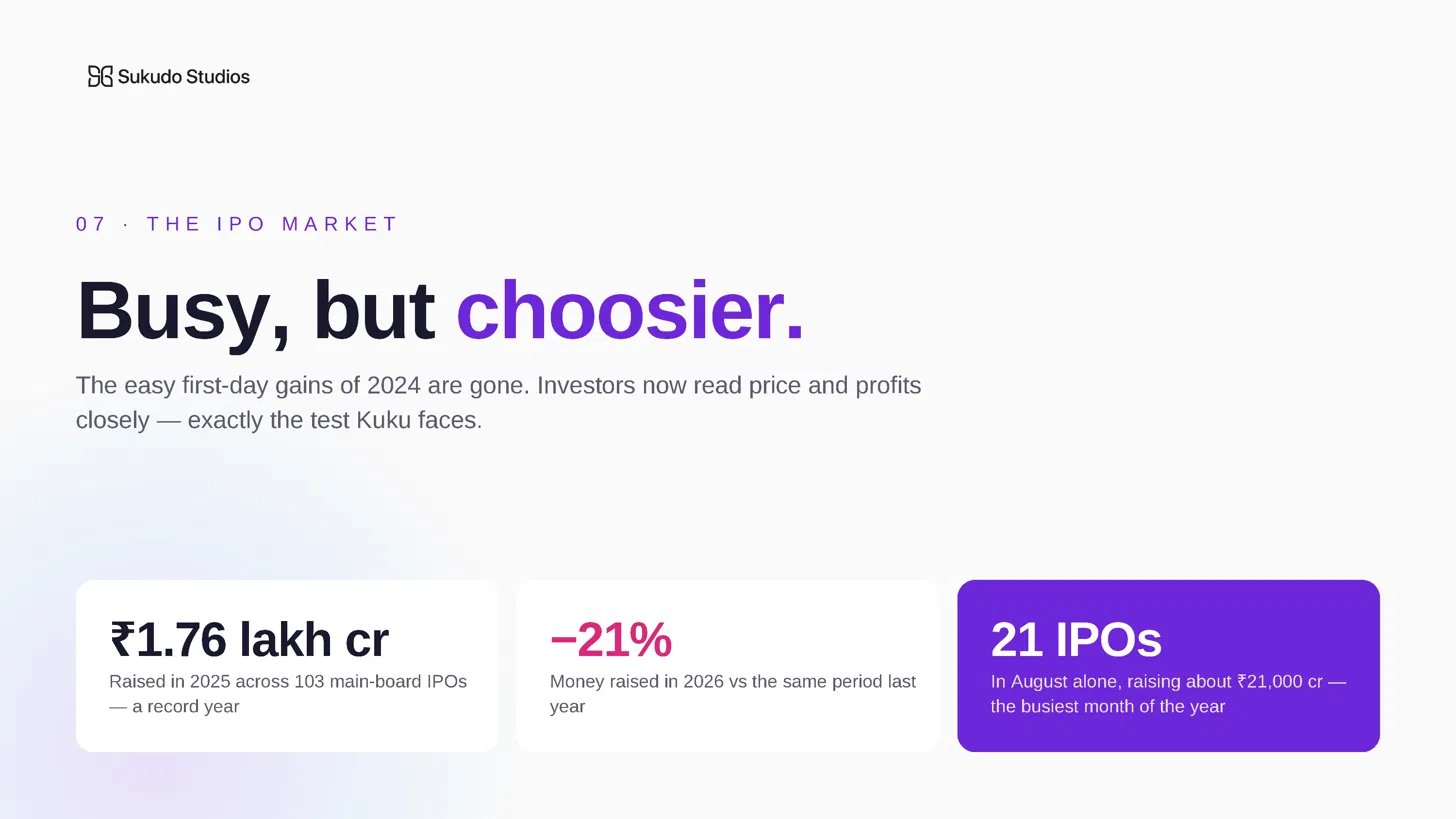
The IPO market: busy, but choosier
According to Prime Database figures reported by BW Businessworld, 2024 and 2025 were record years for Indian IPOs, with 2025 raising about ₹1.76 lakh crore through 103 main-board issues. According to Bloomberg data reported by Outlook Business, money raised in 2026 is down about 21% on the same period last year, as companies cut issue sizes, accepted lower valuations or postponed. According to Navia, August was the busiest month of the year, with 21 main-board IPOs raising about ₹21,000 crore.
What changed most is the reward for investors. According to Navia and ipomarket.in, a handful of issues nearly doubled on debut while others opened flat or lower. According to BW Businessworld, weak performance after listing has made investors more cautious, and they are paying closer attention to price and profits, which is exactly the test Kuku now faces.
Health check | Latest reading | What it tells us | Source |
Economic growth | 7.8% (Apr–Jun 2026) | Strong; ahead of the RBI's 7% estimate | Navia |
Nifty 50, 2026 to date | −10.9% (to 17 Sep) | Weak; share prices lag the economy | Our calculation from Upstox and Business Standard closes |
Deepest fall this year | about −15% (Jan peak to 30 Mar) | A correction, not a crash, but a sharp one | Our estimate, based on Advisorkhoj index-fund data and the Kotak Neo close |
Foreign selling, 2026 | ₹2.37 lakh crore | The main drag; larger than all of 2025 | NSDL via Angel One |
Repo rate | 5.25%, on hold | Neutral; room to cut if inflation eases | Navia |
Crude oil | above $100 a barrel | The biggest outside risk for India | Angel One |
NSE-listed market value | ₹490 lakh crore (end Aug) | Above end-2025 (₹473.6 lakh crore) | Navia; Upstox |
IPO activity | Busiest month in Aug; NSE open now | Window open but selective | Navia; Groww |

The rest of FY 2026-27: three scenarios
The financial year runs to 31 March 2027. Nobody can forecast the market reliably over six months, so rather than a single prediction, here are three scenarios with the conditions that would produce each. The ranges below are our own illustrations for this study, not taken from any source, and are not forecasts or advice.
Bear case Our illustration, not from any source Nifty 50 range by March 2027: 20,800–22,300 Oil climbs back above $110 as West Asia tensions persist, the US Federal Reserve raises rates again, and foreign selling continues. The March low gives way. For IPOs: NSE lists weakly, Jio and Kuku wait; more deals are cut in size or postponed. |
Base case Our illustration, not from any source Nifty 50 range by March 2027: 22,500–25,000 Oil eases gradually, the RBI cuts once if inflation allows, second-quarter results are steady, and domestic funds keep buying. The index moves sideways with swings. For IPOs: a steady flow of mid-sized deals; Jio lists in the coming months; Kuku keeps its H1 2027 slot, perhaps at a trimmed valuation. |
Bull case Our illustration, not from any source Nifty 50 range by March 2027: 25,500–26,500 US–Iran tensions ease, crude falls well below $100, foreign investors return in size, and strong growth feeds into earnings upgrades. The January high is retested. For IPOs: a crowded window; Kuku could bring its listing forward and defend the ₹15,000 crore ask. |
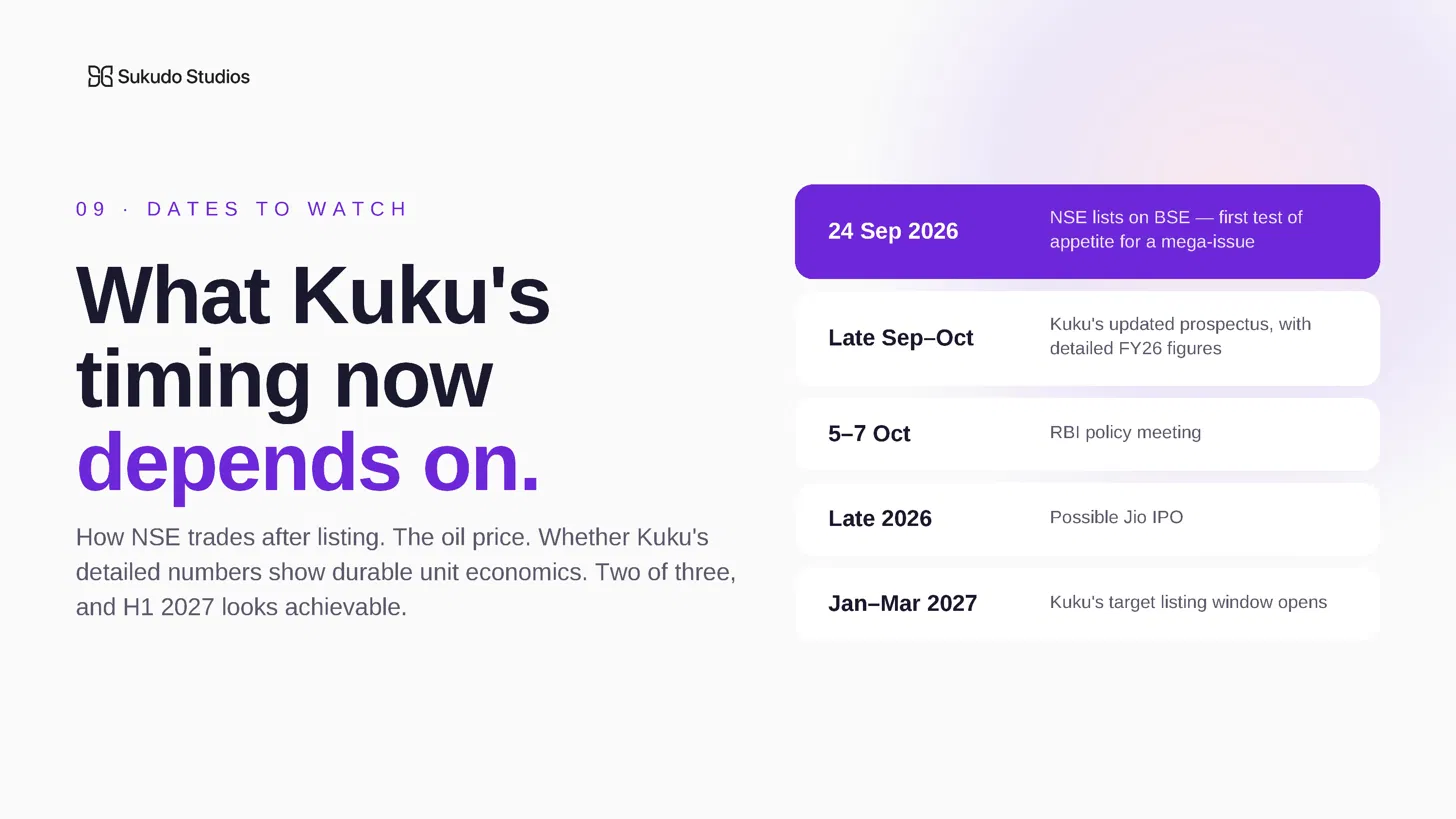
Dates to watch before March 2027
21–24 September 2026 | According to Groww (citing NSE's prospectus), NSE's IPO closes on the 21st, allotment is on the 22nd, and listing on BSE is scheduled for the 24th (tentative). The first real test of investor appetite for a mega-issue this year. |
Late September to October | According to The Economic Times, Kuku's updated prospectus is expected, which should reveal detailed FY26 figures. |
5–7 October | RBI policy meeting, according to Navia. A rate cut would support share prices; a hold with a cautious tone would not. |
October–November | July–September company results, and the festive season as a read on consumer demand. |
Late 2026 | Possible Jio IPO. According to Kotak Neo, SEBI approved it on 28 August; the date has not been announced. |
1 February 2027 (expected) | Union Budget, on its usual date (not yet officially announced): tax and spending signals often move the market. |
January–March 2027 | Start of Kuku's target listing window, according to The Economic Times, and the close of FY 2026-27. |
What Kuku's timing now depends on
Three things matter most. First, how NSE trades after listing: a clean debut will reassure investors that big issues can still be absorbed. Second, the oil price, which drives both inflation and foreign flows into India. Third, whether Kuku's detailed numbers, once published, show that the FY26 jump in revenue came with durable unit economics rather than heavy marketing. If two of the three go Kuku's way, an H1 2027 listing near its target looks achievable. If they do not, a smaller issue or a lower valuation is the likelier adjustment than another long delay.
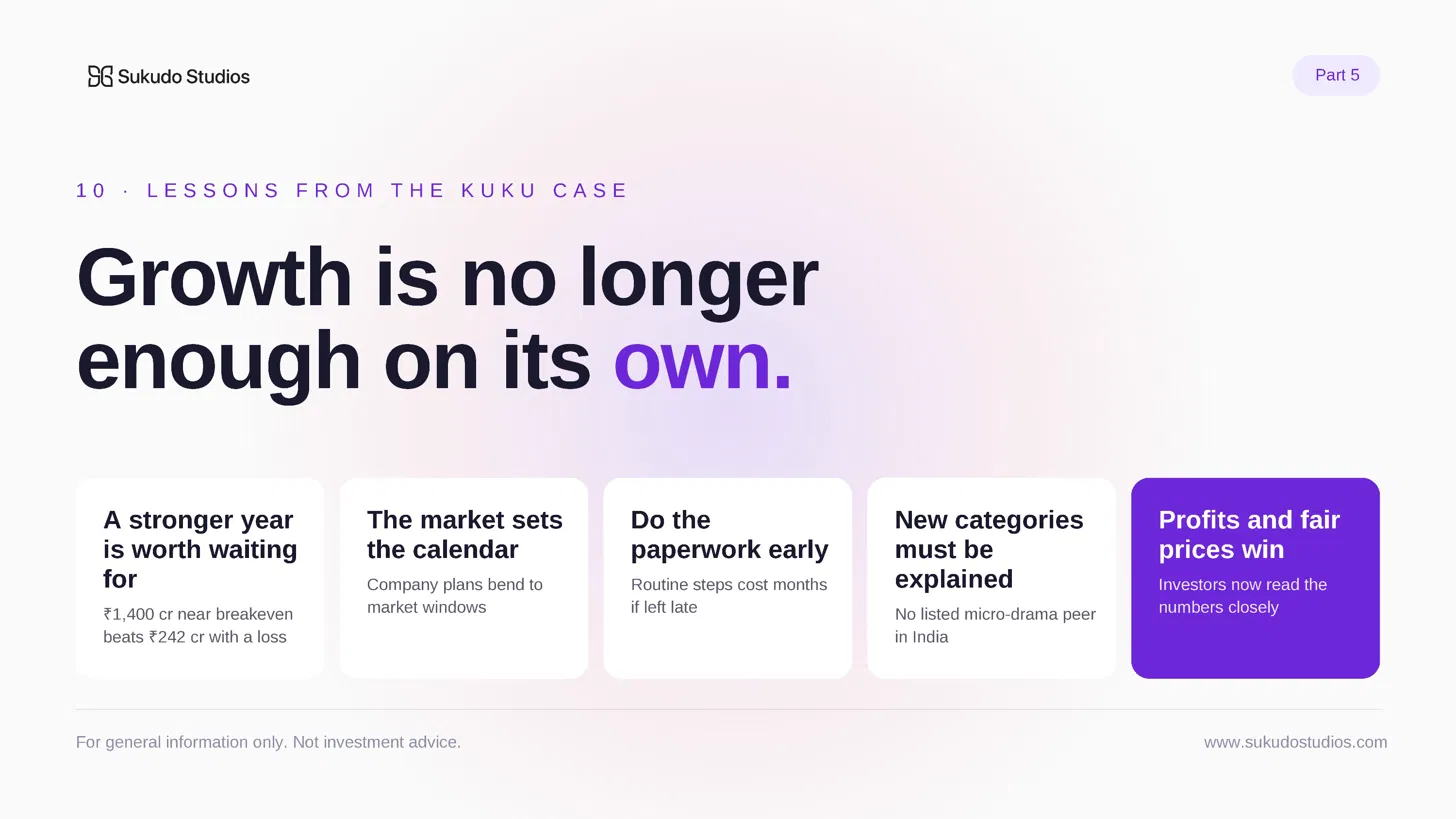
Lessons from the Kuku case
A stronger year is worth waiting for. According to Moneycontrol, it is seen that estimates suggest ₹1,400 crore of FY26 revenue and near-breakeven accounts, which is a different pitch from the ₹242 crore of revenue and ₹153 crore loss shown for FY25. Delaying by a quarter to report the better year was likely worth more than any timetable.
The market sets the calendar. Kuku, NSE and Jio all slipped from early-2026 plans and all filed in June. Company plans bend to market windows, not the other way round.
Do the paperwork early. Converting to a public company and tidying the corporate structure are routine, but they can cost months if left late.
New categories must be explained. With no listed micro-drama company in India, Kuku has to teach investors what a micro-drama business is and how it makes money, on top of selling its own story.
Growth is no longer enough on its own. The 2026 IPO market rewards companies with clear profits and fair prices. The easy first-day gains of 2024 are gone, and investors now read the numbers closely.
This case study is for general information and education. It is not investment advice or a recommendation to buy or sell any security. Sukudo Studios is not a SEBI-registered adviser. Please consult a registered professional before making investment decisions.