This Is Not a Dubbing Story
Every other case study on this page describes a client who came to Sukudo Studios for dubbing or subtitling. This one is different.
FreeReels and DramaWave, two of the world's fastest-growing micro drama platforms did not come to Sukudo Studios looking for a dubbing vendor. They came looking for an answer to a question that was costing them millions in unrealised revenue: Why is India not working?
The platforms had everything a micro drama app needs to succeed a massive content library, advanced AI-driven recommendation engines, global distribution, and the backing of a publicly traded technology conglomerate. They were performing well in the United States, Europe, and Southeast Asia. But India the world's largest mobile-first entertainment market, with 886 million active internet users was not responding the way the numbers said it should.
Sukudo Studios was brought in not to dub a few shows, but to diagnose why. What followed was a comprehensive localization audit that uncovered seven critical gaps between the platforms and the Indian market, gaps that no amount of content investment could fix without deep local market intelligence.
The recommendations were implemented. FreeReels reached number one on the Google Play Store in India.
This is the story of how that happened.
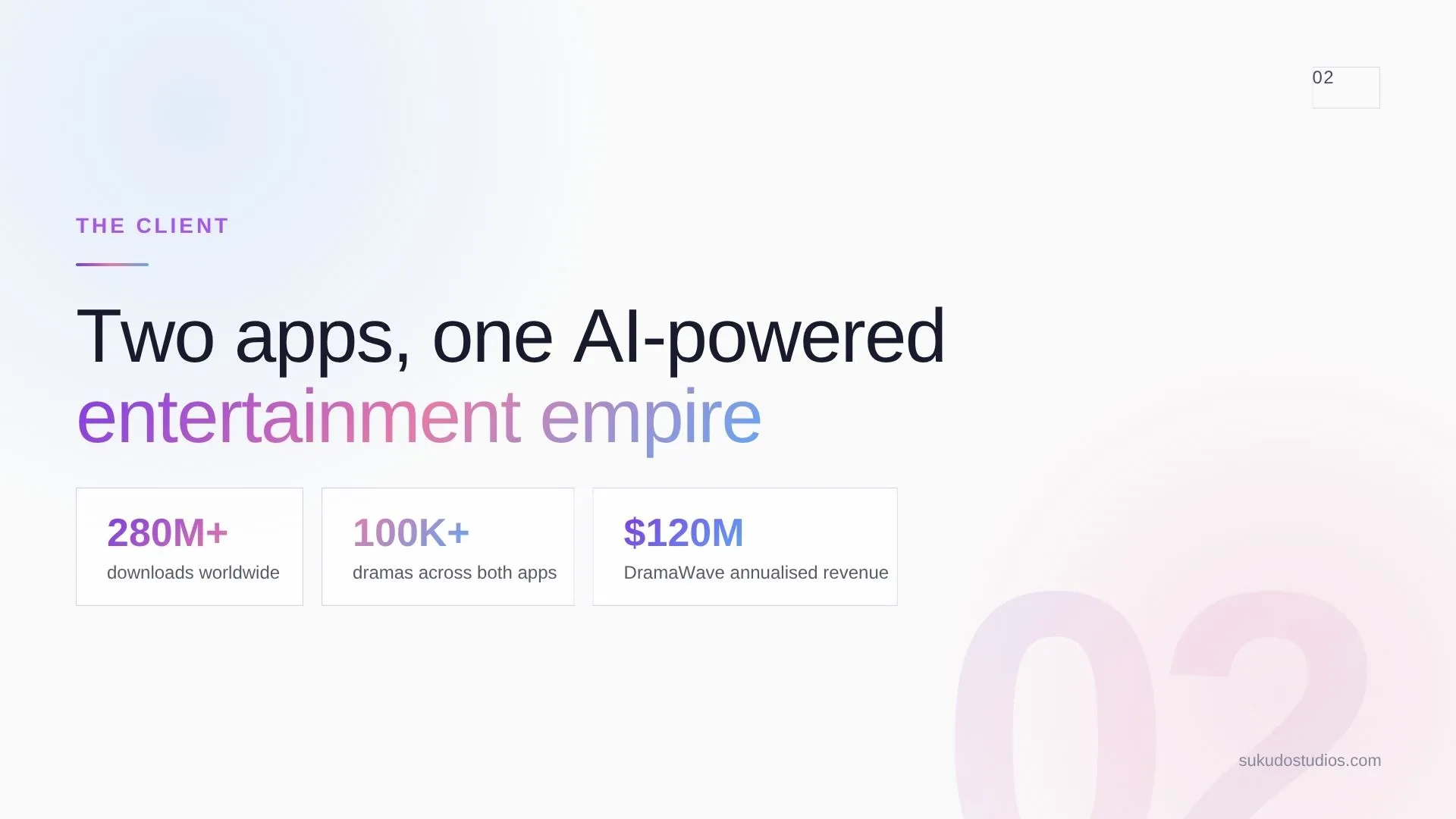
The Client: Two Apps, One AI-Powered Entertainment Empire
FreeReels and DramaWave are sister platforms operated by SKYWORK AI PTE. LTD., the entertainment arm of Kunlun Tech a publicly traded Chinese technology conglomerate headquartered in Beijing.
Kunlun Tech is not a typical media company. It operates at the intersection of artificial intelligence and entertainment, having built Skywork (a family of large language models), SkyReels (an AI-powered short drama creation platform), and a portfolio of consumer-facing apps spanning social networking, music, and video streaming. The company's AI research consistently ranks among the world's most advanced its Skywork Super Agents platform topped the GAIA benchmark, surpassing OpenAI's Deep Research.
Within this ecosystem, FreeReels and DramaWave represent Kunlun Tech's two-pronged strategy for capturing the global micro drama market:
DramaWave is the premium platform. Launched in September 2024, it operates on a subscription and in-app purchase model, offering over 30,000 dramas across 18 languages in 1080p streaming quality. DramaWave generates an annualised recurring revenue of approximately $120 million, with a monthly revenue run rate of around $10 million. It targets audiences willing to pay for exclusive, high-quality content.
FreeReels is the scale play. Built on an entirely free, ad-supported model, FreeReels offers over 70,000 dramas across 17+ languages with zero subscription fees. The proposition is simple: unlimited entertainment, completely free, funded by advertising revenue. The strategy is designed to capture the widest possible audience particularly in price-sensitive markets like India, where subscription fatigue is real and free content has a structural advantage.
The numbers are staggering. As of April 2026, FreeReels has been downloaded over 280 million times globally, averaging approximately 5.3 million downloads per day. It carries a 4.82-star rating from over 1.1 million reviews. TechCrunch, in an April 2026 report on India's booming app market, specifically named FreeReels as the app leading the 400%+ surge in short drama platform downloads in the country.
But these numbers did not come easily. Before Sukudo Studios entered the picture, the India story looked very different.
The India Paradox: 886 Million Users, Underwhelming Growth
On paper, India is the single most attractive market for any mobile entertainment platform in the world.
The country has 886 million active internet users a number larger than the entire population of Europe. Seventy-four percent of Indian users consume content primarily on mobile devices. The micro drama format vertical, short-form, swipe-to-watch is tailor-made for this audience. And the Indian micro drama market itself is growing at a compound annual growth rate estimated between 50% and 75%, driven by falling data costs, rising smartphone penetration, and an insatiable appetite for dramatic storytelling.
There was just one problem. Despite having a massive global content library and sophisticated AI-driven recommendations, FreeReels and DramaWave were not capturing the Indian market at the rate their potential warranted. Growth was below expectations. User acquisition was happening, but engagement and retention were lagging. The content was there. The audience was there. Something in between was broken.
This is the classic trap that global platforms fall into when entering India. The market is so large and so obviously valuable that companies assume their existing product perhaps with Hindi translations layered on top will work. It almost never does. India is not a single market. It is a continent-sized mosaic of languages, cultural preferences, payment habits, pricing expectations, and user experience conventions that differ fundamentally from every other market on earth.
FreeReels and DramaWave needed someone who understood this mosaic. Not a dubbing vendor who could translate scripts. A partner who could decode India.
The Engagement: Indian Localization Partner
Sukudo Studios was engaged as the Indian Localization Partner for both FreeReels and DramaWave, a role that went far beyond dubbing and subtitling.
The mandate was comprehensive: research the Indian micro drama landscape, benchmark FreeReels and DramaWave against Indian-market leaders, identify every gap between the current product and Indian user expectations, and deliver actionable recommendations backed by competitive intelligence and cultural insight.
Sukudo's team conducted a systematic audit across multiple dimensions content, language, user experience, conversion flow, pricing, payments, and marketing. The research included side-by-side comparisons with Indian-market leaders like KukuTV (India's largest micro drama platform, with over 180 million downloads and 10 million paid subscribers), analysis of Indian consumer behaviour patterns, and hands-on testing of the app experience from the perspective of different Indian user segments.
The findings were presented to the DramaWave and FreeReels leadership in a series of structured meetings. Seven critical gaps were identified each one a specific, fixable barrier between the platforms and the Indian audience they were trying to reach.
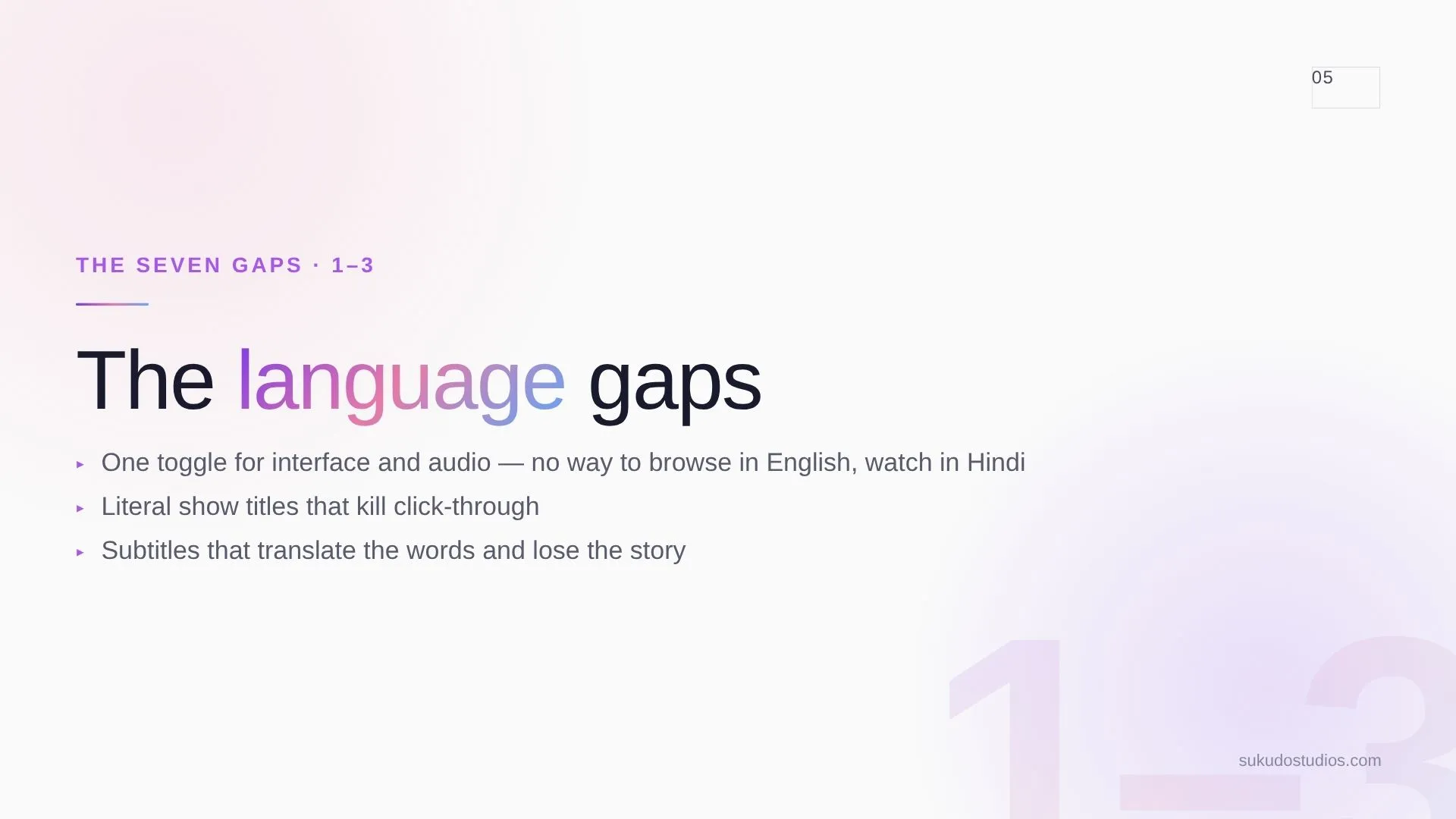
Gap 1: The Language Architecture Problem
India has one of the most complex linguistic landscapes of any market in the world. Twenty-two officially recognised languages. Hundreds of dialects. And a unique relationship between English and regional languages that does not exist anywhere else.
Here is what most global platforms misunderstand about Indian language preferences: seventy percent of Indian users prefer to consume content with audio in their native language. But and this is critical, India's premium, urban, digitally sophisticated audience overwhelmingly prefers to navigate app interfaces in English. These are not contradictory preferences. They are complementary ones. An Indian user in Mumbai or Bangalore wants to browse an app in English (because English signifies quality, modernity, and global credibility) while watching content dubbed in Hindi, Tamil, or Telugu.
DramaWave's language architecture did not account for this duality. The app offered a single language toggle that switched the entire interface menus, titles, descriptions, and audio content to the selected language simultaneously. There was no way to keep the interface in English while separately choosing a preferred audio language.
This created a cascading user experience problem. When a premium Indian user switched the app language to Hindi to access Hindi-dubbed content, the entire interface became a word-for-word Hindi translation cluttered, overly literal, and foreign to the navigation patterns these users were accustomed to. Conversely, when a user kept the interface in English, they could only see English-audio content missing the Hindi-dubbed titles entirely.
The fix was structural but straightforward: separate the interface language from the audio/content language preference. Let users browse in English while selecting Hindi (or any other Indian language) as their preferred audio and subtitle language. This is how India's most successful streaming platforms from JioHotstar to KukuTV handle the same challenge.
Gap 2: Title Localization That Kills Click-Through
In the micro drama format, the title is the first and often only piece of information a user sees before deciding whether to tap on a show. Titles are not metadata. They are marketing. A compelling title creates curiosity, signals genre, and promises an emotional payoff. A weak title is invisible.
DramaWave and FreeReels were translating their show titles from Chinese and English into Hindi using literal, word-for-word translation. The results were technically accurate and commercially catastrophic.
Consider an example from the audit. A Chinese romance drama had been given a literal Hindi title that roughly translated to "The Reincarnated Fat Bride Who Is the Love of the King." While this was a faithful rendering of the original Chinese title, it read as absurd and off-putting to an Indian audience. Sukudo's localization team, after reviewing the show's genre and plot, proposed an adapted title that captured the emotional essence of the story, a title that conveyed longing, fate, and incomplete love in a way that resonated with Indian romantic drama conventions.
This was not a one-off problem. Across the platform's Indian library, show after show suffered from the same issue. Titles that should have stopped a scrolling thumb instead made users scroll past. The localization team at Sukudo Studios reworked titles by studying each show's genre, plot, and emotional arc creating Hindi titles that were not translations but original pieces of micro-copy engineered for the Indian audience's sensibility.
The same problem extended to show posters and thumbnails. Visual assets paired with literal titles created a compounding effect: the show looked unappealing at every touchpoint. Sukudo's recommendation was a comprehensive title and poster localization pass across the entire Indian content library, treating each title as a marketing asset, not a translation exercise.
Gap 3: Subtitles That Lose the Story
For shows where Hindi dubbing was not yet available, subtitles were the only bridge between the content and the Indian viewer. And that bridge was cracking.
The subtitle translations on the platform were literal produced through direct translation that preserved the dictionary meaning of each word but lost the emotional and cultural meaning of the dialogue. In a format where every line needs to land within seconds, subtitles that read like textbook translations are not just suboptimal. They are story-breaking.
The audit identified a pattern that was particularly damaging: the treatment of idioms, figures of speech, and emotionally charged dialogue. When a character in a dramatic confrontation says "I'm at my breaking point" a common English idiom meaning they can no longer endure the situation the literal Hindi translation on the platform rendered this as a flat, technical-sounding statement that communicated the dictionary definition but none of the emotional intensity.
Sukudo's writing team demonstrated the difference through side-by-side comparisons. For each example, the literal translation was placed alongside a culturally adapted Hindi version that carried the same emotional weight, urgency, and dramatic impact as the original dialogue. The adapted versions used natural Hindi expressions, colloquialisms, and emotional registers that an Indian viewer would instinctively connect with.
The recommendation was to run the subtitle pipeline through Sukudo's cultural adaptation process ensuring that every subtitle, across every show available in India, carried the emotional architecture of the original rather than just its words.
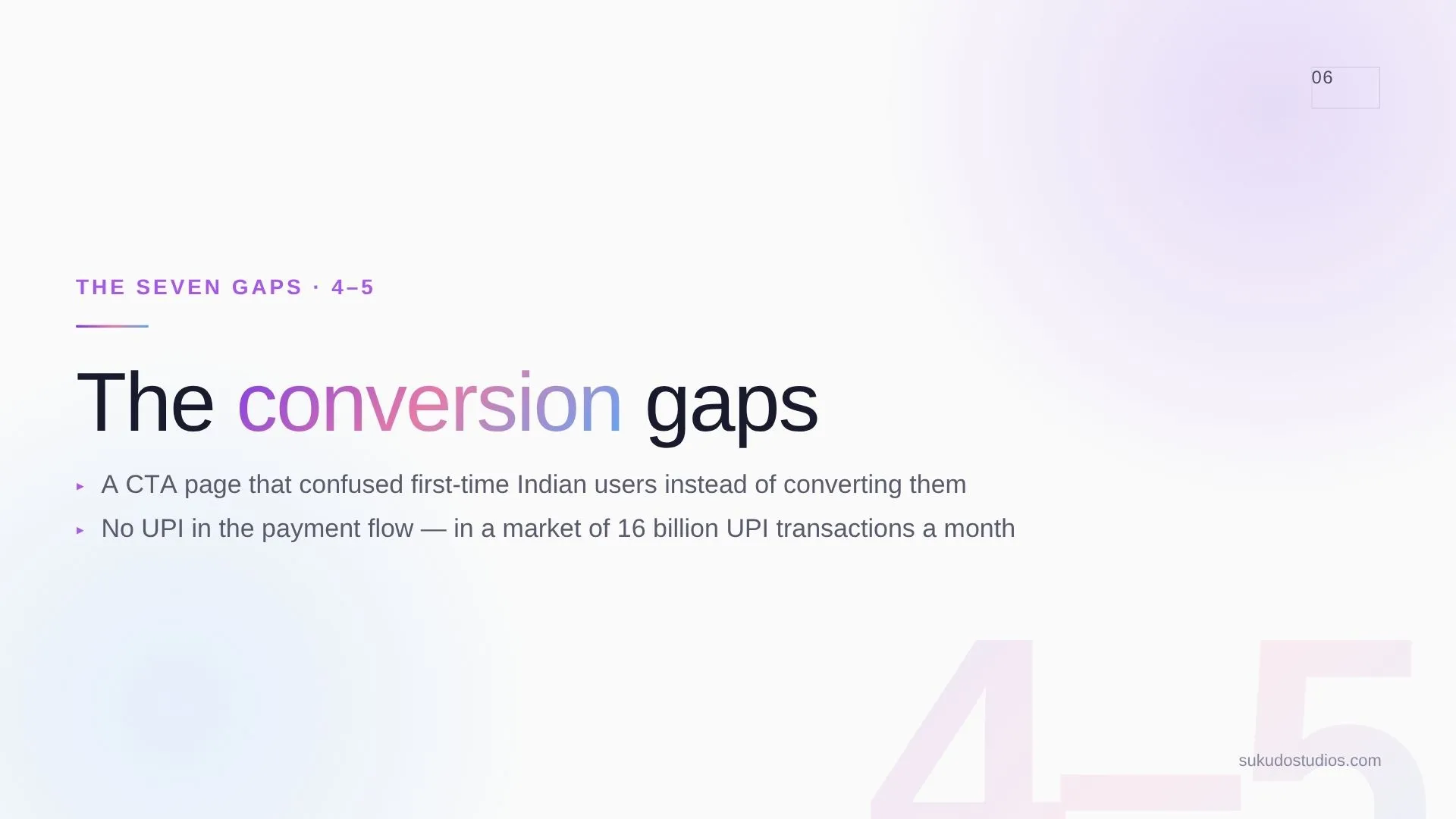
Gap 4: A Call-to-Action Page That Confused Instead of Converted
First impressions in a mobile app are measured in seconds. When a new user lands on a call-to-action page, the screen that explains what the app offers and why they should engage further the design needs to be immediately clear, visually compelling, and persuasive.
The audit found that DramaWave's CTA page was cluttered and poorly structured for Indian first-time users. The user interface was scattered, with no clear visual hierarchy guiding the user toward the next action. For someone opening the app for the first time, there was no intuitive path forward no clear message about what the platform offered, why it was worth their time, or what they should do next.
By contrast, Indian competitors had refined their onboarding flows to a science. The audit highlighted KukuTV's CTA page as a benchmark featuring a video that explained the platform's content, subscription model, and value proposition in the user's preferred language. The video format was particularly effective because it communicated through demonstration rather than text, reducing cognitive load for users who were encountering the micro drama format for the first time.
Sukudo recommended a redesigned CTA flow inspired by Indian-market best practices, including a localized explainer video that Sukudo's team offered to produce walking new Indian users through the app's content library, demonstrating how to discover shows, and clearly communicating the value proposition in a way that felt native and trustworthy.
Gap 5: The Payment Gateway Friction
This was one of the most impactful findings in the audit not for FreeReels (which is entirely free and ad-supported) but for DramaWave's subscription and in-app purchase model.
India has undergone a payments revolution. The Unified Payments Interface (UPI) a real-time payment system developed by the National Payments Corporation of India has become the dominant digital payment method in the country. In 2025, UPI processed over 16 billion transactions per month. Apps like PhonePe, Google Pay (GPay), and Paytm have become as fundamental to Indian daily life as WhatsApp.
DramaWave's payment flow redirected Android users to Google Play's standard payment gateway. While functional, this flow bypassed the payment method that Indian users were most comfortable with and most likely to complete a transaction through. Every additional step, every unfamiliar payment screen, every redirect away from a familiar interface increases the probability that a user will abandon the purchase and tell themselves they will come back later. In mobile commerce, "later" almost always means "never."
Indian competitors had already solved this. KukuTV, for example, integrated PhonePe, GPay, and Paytm directly into its payment flow reducing the number of steps between the decision to subscribe and the completed transaction. More strategically, KukuTV offered a seven-day trial for just ₹2 (approximately 0.15 yuan), during which the app set up an autopay mandate on the user's UPI app. At the end of the trial, the subscription activated automatically converting trial users into paying subscribers with minimal friction.
The recommendation for DramaWave was to integrate UPI payment options directly into the app's payment flow for the Indian market, and to consider a low-cost trial strategy with autopay setup a proven conversion mechanism in the Indian subscription economy.
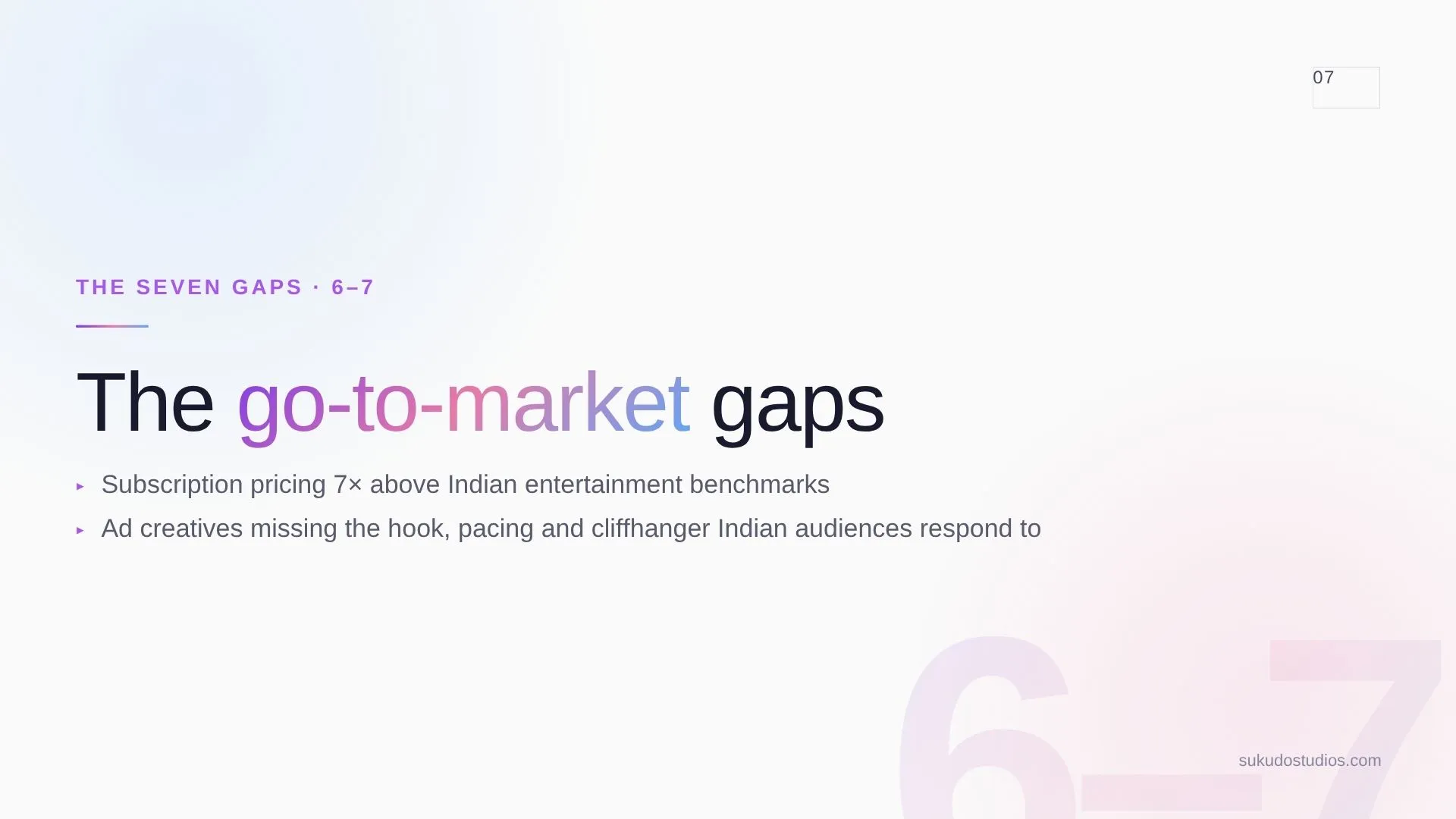
Gap 6: The Pricing Chasm
While FreeReels sidesteps the pricing question entirely through its free, ad-supported model, DramaWave's subscription pricing presented a significant barrier in the Indian market.
The audit included a detailed pricing comparison against the entertainment platforms that Indian consumers use daily. The findings revealed a stark reality: DramaWave's subscription price was approximately seven times higher than the average price Indian audiences were accustomed to paying for entertainment content.
The benchmarks told the story clearly. Netflix India's most affordable plan was approximately ₹149 per month (roughly 12 yuan). Amazon Prime Video was available at approximately ₹299 per month (around 23 yuan). JioHotstar, leveraging Reliance Jio's massive distribution network, offered a three-month subscription for approximately ₹149 (around 12 yuan total just 4 yuan per month). Among micro drama competitors, KukuTV priced its three-month plan at approximately ₹499 (around 39 yuan for three months).
DramaWave, by comparison, was charging approximately ₹1,199 for a single month (around 93 yuan) placing it in a pricing tier that even premium Indian consumers found difficult to justify, particularly when free alternatives like FreeReels existed in the same category.
This pricing chasm was not just a conversion barrier it was a perception problem. Indian consumers who encountered the price point before experiencing the content were likely forming a negative impression of the platform's value proposition, making them less likely to engage even with free content or trial offers.
The recommendation was a comprehensive pricing restructuring for the Indian market aligning DramaWave's subscription tiers with Indian willingness-to-pay benchmarks while maintaining premium positioning through content quality and exclusive titles.
Gap 7: Ad Creatives That Miss the Indian Hook
User acquisition in the micro drama industry is driven heavily by performance marketing short video ads on platforms like Instagram, YouTube, and Facebook that hook viewers in the first two seconds and drive them to download the app. The creative quality and cultural relevance of these ads directly determines the cost of user acquisition and the quality of users acquired.
The audit found that the ad creatives being used for the Indian market were not calibrated for Indian audience psychology. Indian micro drama ads that perform well follow a specific formula: they open with a strong emotional hook (romance, betrayal, revenge, a shocking revelation), establish dramatic tension within seconds, and end on a cliffhanger that creates an irresistible urge to find out what happens next.
To demonstrate this, Sukudo Studios' in-house editing team produced a sample ad creative using one of DramaWave's existing shows. The ad was designed using Indian-market creative conventions a provocative hook, rapid emotional escalation, and a cliffhanger cut showing the platform's leadership exactly how the same content could be repackaged for dramatically higher engagement with Indian audiences.
The recommendation was for Sukudo's creative team to collaborate on Indian-market ad production, ensuring that every performance marketing creative was optimised for the hooks, pacing, and emotional triggers that drive downloads in India.
What Sukudo Studios Delivered
The scope of Sukudo Studios' engagement with FreeReels and DramaWave extends across every dimension of Indian market localization:
Hindi dubbing- for the platforms' content libraries, bringing Chinese-language originals to life in Hindi with cultural adaptation, emotional accuracy, and consistent character voice quality.
Subtitle localization- replacing literal translations with culturally adapted, emotionally resonant Hindi subtitles that preserve the storytelling impact of the original dialogue.
Title and poster localization- reworking show titles and visual assets for the Indian market by analysing each show's genre, plot, and emotional arc, and creating Hindi titles that function as compelling marketing copy rather than flat translations.
Competitive market research- systematic benchmarking of the platforms against Indian market leaders across user experience, pricing, payments, content strategy, and conversion flows.
UX and conversion consulting- actionable recommendations on language architecture, CTA page design, payment gateway integration, and onboarding flow optimization.
Ad creative production- sample Indian-market ad creatives demonstrating culturally calibrated hooks, pacing, and emotional triggers.
Pricing and monetization strategy input- comparative analysis of Indian entertainment pricing and recommendations for market-appropriate subscription tiers.
Ongoing strategic partnership- with continued discussions around future initiatives including Indian original productions with known Indian talent, urban and rural market positioning, differentiated content verticals, and untapped audience segments.
The Result: Number One
The recommendations were not theoretical. The FreeReels and DramaWave teams acted on them.
Across multiple meetings and collaborative sessions, Sukudo's findings were reviewed, debated, and implemented. Some recommendations were adopted immediately title localization, subtitle quality improvements, dubbing workflows, and ad creative strategies. Others pricing restructuring, payment gateway integration, original Indian content entered longer-term planning cycles and remain in active discussion for future phases.
The impact on FreeReels' Indian trajectory was decisive.
FreeReels reached #1 on the Google Play Store in India in the Entertainment category verified on the Play Store listing as of April 2026. For a Chinese-origin platform competing against Indian-made apps like KukuTV, QuickTV, and dozens of local competitors, this is a landmark achievement.
TechCrunch named FreeReels as the leading app driving the 400%+ surge in short drama downloads in India in its April 2026 report on the country's booming app market placing FreeReels at the centre of one of the fastest-growing entertainment categories in the world's largest mobile market.
280 million total downloads globally, approximately 5.3 million downloads per day, with India now established as a core growth market for the platform.
These numbers are the product of many factors content quality, AI-driven recommendations, Kunlun Tech's technology infrastructure, and the marketing team's execution. But at the foundation of FreeReels' Indian success is a truth that global platforms often learn the hard way: technology and content are necessary but not sufficient. India requires a localization partner who understands not just the language, but the market the payment habits, the pricing psychology, the creative conventions, the cultural nuances that determine whether 886 million potential users become actual users.
Sukudo Studios provided that understanding. The #1 ranking is the evidence.
The Lesson: What "Localization Partner" Actually Means
Most dubbing studios define localization as: give us the script, we will translate and record it. That definition is accurate as far as it goes, but it does not go nearly far enough especially for platforms entering a market as complex as India.
True localization is not a post-production service. It is a market intelligence function. It encompasses everything that stands between a global product and local product-market fit: language, yes, but also user experience, conversion design, payment infrastructure, pricing strategy, marketing creative, and cultural positioning.
When Sukudo Studios was brought in as the Indian Localization Partner for FreeReels and DramaWave, the first deliverable was not a dubbed episode. It was a diagnosis a systematic identification of every barrier between two global platforms and the Indian audience they deserved to reach. The dubbing came after. The subtitling came after. The title localization came after. First came the understanding.
This is what separates a localization partner from a localization vendor. A vendor executes tasks. A partner changes outcomes.