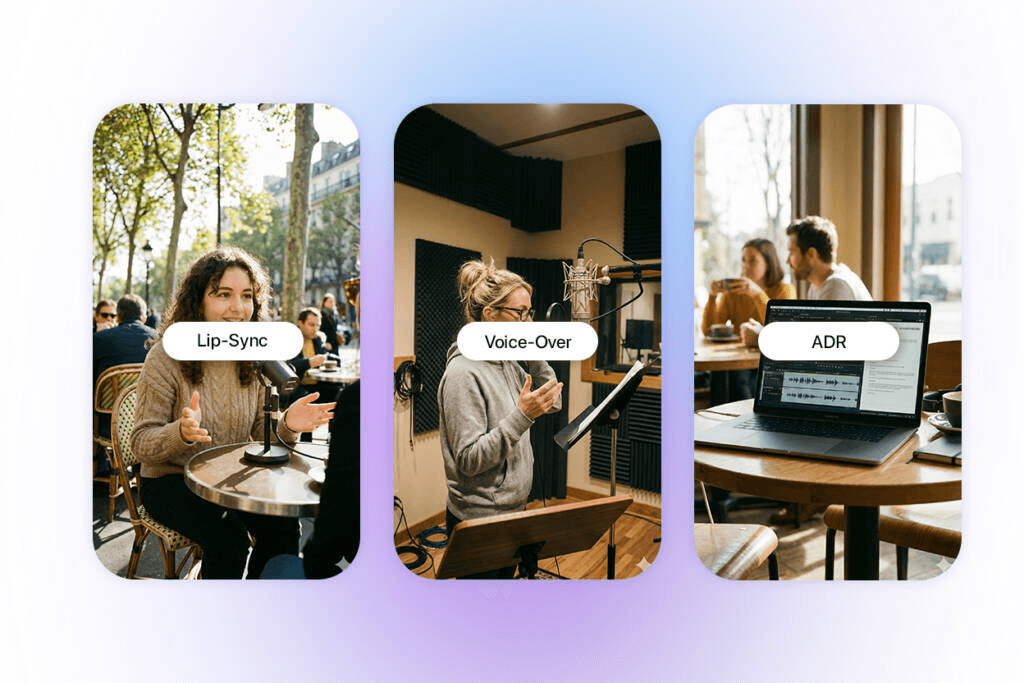
If you’re localizing content, you’ll hear these terms constantly: lip-sync dubbing, voice-over, and ADR.
They are not interchangeable. Choosing the wrong one can:
waste budget,
slow down delivery,
or create an output that feels “off” for the audience.
This guide explains what each method is, how the workflows differ, what deliverables you need, and how OTT platforms, micro-drama apps, production houses, and creators should decide.
Quick Answer
Choose lip-sync dubbing when you need a “native feel” and performance matters (drama, micro-drama, character-driven series).
Choose voice-over when lip-sync is not required and speed/cost efficiency matters (documentary, corporate, e-learning).
Choose ADR when you’re replacing or repairing dialogue in the original production (noise issues, performance re-records, script changes), or when you need controlled studio dialogue that matches picture.
A simple rule:
Localization choice: lip-sync dubbing vs voice-over
Production repair choice: ADR
1) Definitions
What is lip-sync dubbing?
Lip-sync dubbing replaces the original dialogue with new dialogue in a target language and aims to match:
Mouth movements (where possible),
Scene timing,
And performance intent.
It usually requires adaptation, not just translation, because the target-language sentence lengths must fit timing.
Best for: drama, series, micro-drama, animation/anime, character-heavy storytelling.
What is ADR (Automated Dialogue Replacement)?
ADR is a production process where dialogue is re-recorded in a studio to replace or repair original dialogue in the same language (or in another language for localization in some pipelines).
ADR is commonly used when:
original dialogue is noisy or unusable,
the script changes after filming,
performance needs to be re-done,
or the dialogue must be cleaner for the final mix.
Best for: film/series production quality control, dialogue repair, controlled dialogue capture.
2) The Decision Table
Use this table to align your team quickly.
Content Type / Goal | Best Choice | Why |
OTT drama / romance / thriller | Lip-sync dubbing | Performance + immersion drives retention |
Vertical micro-drama | Lip-sync dubbing (or tight timed dub) | Fast dialogue + mobile viewing needs natural pacing |
Animation / anime | Lip-sync dubbing | Characters and performance are core |
Documentary | Voice-over | Lip-sync not critical; speed and clarity matter |
Corporate / e-learning | Voice-over or subtitles | Efficiency and clarity |
YouTube tutorials | Subtitles first, then dubbing for top markets | Speed to global reach, then deeper engagement |
Film production dialogue repair | ADR | Fix noisy lines and performance issues |
Fixing on-set noise / mic issues | ADR | Clean studio dialogue replaces unusable audio |
Post-shoot script change | ADR | Re-record specific lines to match new edits |
Key takeaway: ADR is usually about fixing dialogue, while dubbing/voice-over is about localizing content.
3) Lip-Sync Dubbing Workflow
Lip-sync dubbing is not just “recording with timing.” It changes the front half of the pipeline.
Step A: Adaptation becomes mandatory
Translation must become “dub-adaptation,” which means:
meaning + intent preserved,
sentence length adjusted,
natural phrasing maintained,
performance beats preserved.
This is often called lip-sync script adaptation.
Step B: Recording becomes performance + timing discipline
Actors must:
deliver emotion,
match pacing,
and land key syllables at the right moment.
Direction quality becomes a major differentiator here.
Step C: Sync pass becomes more intensive
Editors focus on:
early/late entries,
close-up moments,
pacing and breath timing,
and continuity across scenes.
Step D: Mix must feel native
The final dub should sit naturally in the scene with music and effects, and meet platform specs.
Lip-sync dubbing is the most immersive option—but it has the highest bar.
4) Voice-Over Workflow
Voice-over is often misunderstood as “cheap dubbing.” It’s not. It’s a different product.
Voice-over works best when:
the original audio can remain in the background,
the content is informational,
and you want clarity and speed.
Workflow
Script translation (usually less adaptation effort than lip-sync)
Voice selection (often 1 voice, sometimes 2)
Recording (focus on clarity and pacing)
Light edit and mix (balance with original track)
QC (pronunciation, timing, loudness)
Delivery
Common voice-over mistake
Trying to voice-over a drama scene. It usually feels unnatural because the audience expects character performance, not narration-style delivery.
5) ADR Workflow
ADR is a core part of professional film/series post production.
When ADR is needed
noisy dialogue recorded on set (traffic, crowd, wind)
microphone issues
script changes after edit
performance improvements
continuity fixes (matching edits)
ADR process
Identify lines needing replacement (ADR cue sheet)
Prepare timecoded cues and reference audio
Studio recording: actor matches timing and emotion
Edit and sync (tight alignment to picture)
Blend with ambience/room tone
Mix into the final soundtrack
QC (sync, noise, loudness, continuity)
ADR’s goal is to make the replacement invisible.
ADR deliverables
ADR recorded dialogue takes
Edited/synced dialogue stems
Final mix integration (if part of scope)
Documentation (cue sheet, version notes)
6) Deliverables Checklist
Whether you choose lip-sync, voice-over, or ADR, deliverables must be clear.
For Lip-Sync Dubbing
Dub-adapted script (per episode/scene)
Final dubbed mix (stereo/5.1 per spec)
QC report (language + sync + audio)
Version log and packaging
Optional: dialogue-only export, stems
For Voice-Over
Translated script (with pronunciation notes if needed)
Final VO mix
QC notes (timing/clarity)
Packaging and naming
For ADR
ADR cue sheet (timecoded)
Recorded takes (organized)
Edited and synced dialogue
Integration into mix (if included)
Version notes
If you don’t specify deliverables, you will pay later in delays and rework.
7) Cost and Timeline Drivers
Lip-sync dubbing cost drivers
adaptation complexity
sync intensity
cast size
revision cycles
deliverables complexity (stems, 5.1, M&E availability)
Voice-over cost drivers
voice talent quality
script length
number of voices
turnaround time
ADR cost drivers
number of lines to replace
actor availability
sync difficulty
complexity of blending into original mix
The biggest budget killer across all three: late changes and slow approvals.
8) Common Mistakes
Mistake 1: Choosing voice-over for drama
Fix: if performance matters, use dubbing (lip-sync or timed).
Mistake 2: Skipping adaptation in lip-sync dubbing
Fix: add an adaptation stage and a glossary/style guide.
Mistake 3: Treating ADR as “just re-recording”
Fix: ADR must be edited, synced, and blended with ambience to feel invisible.
Mistake 4: No defined spec and packaging rules
Fix: lock deliverables, naming conventions, loudness targets before production.
Mistake 5: No pilot test
Fix: run one pilot scene or one pilot episode to validate before scaling.
If you’re unsure which method is right, the fastest way to decide is a pilot:
1 episode (or 1 representative scene)
1 language
clear deliverables spec
We can propose the best-fit approach based on your content type and goals. Contact Sukudo Studios Today!